The best junk journal page ideas fall into a few simple types:
layered backgrounds, pocket and tuck pages, themed spreads, and
interactive fold-outs. Once you know the building blocks, you can mix
them into endless pages without ever running out of ideas.
Staring at a blank spread is the hardest part of junk journaling, and
it hits everyone, not just beginners. The fix is not more inspiration,
it is a small set of reliable formulas you can reach for. This page
gives you those formulas, grouped so you can flip to whatever fits the
mood and the scraps you have on hand.
If you are new to the format itself, our complete junk journaling guide covers the building blocks; this page focuses on what to actually put on the spreads.
Work through a few and you will notice your own style start to show
up: maybe you love deep layers, maybe clean pockets, maybe a single
photo with room to write. That is the real goal here. The ideas are a
starting point, not a rulebook.
The short version: Build most pages from four moves:
a layered background, a focal point, a pocket or tuck for keepsakes, and
an aged edge. Themes (travel, seasonal, nature) give a spread direction.
Interactive bits (flaps, fold-outs, dangles) are what make people flip
back through your journal.
Layered background page
ideas
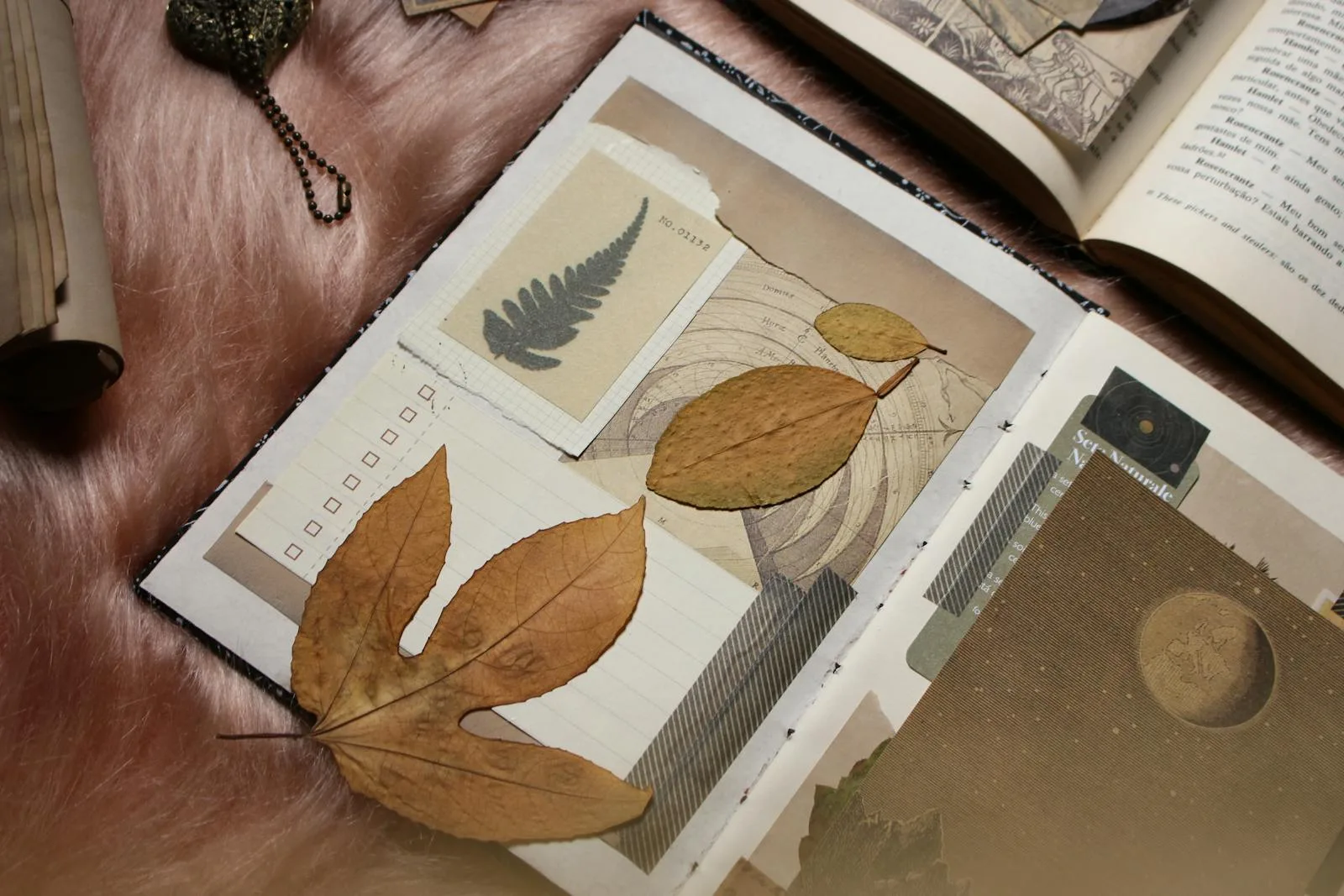
Layered backgrounds are the foundation of the junk journal look: two
or three sheets glued over each other so the page has depth before you
add anything else. They turn a plain page into something that feels
collected.
Ideas to try:
Book page wash. Glue a full dictionary or novel
page across the spread, then add a light watercolor or coffee wash over
it.
Patchwork paper. Overlap three or four scraps of
different patterns and weights, edges showing.
Ledger and music base. Old ledger paper or sheet
music makes an instant vintage backdrop.
Torn-edge layers. Tear instead of cut for soft
white edges, then stack from large to small.
Color-tied page. Pull only scraps in one color
family for a calm, cohesive base.
If your layers keep lifting at the corners, it is almost always the
glue. Our glue guide covers
what holds heavier paper flat.
Pocket and tuck page ideas
Pocket pages add a place to tuck tags, notes, photos, and keepsakes,
which makes a journal interactive instead of flat. They are the single
best way to make a page feel special, and they are easy to build.
Ideas to try:
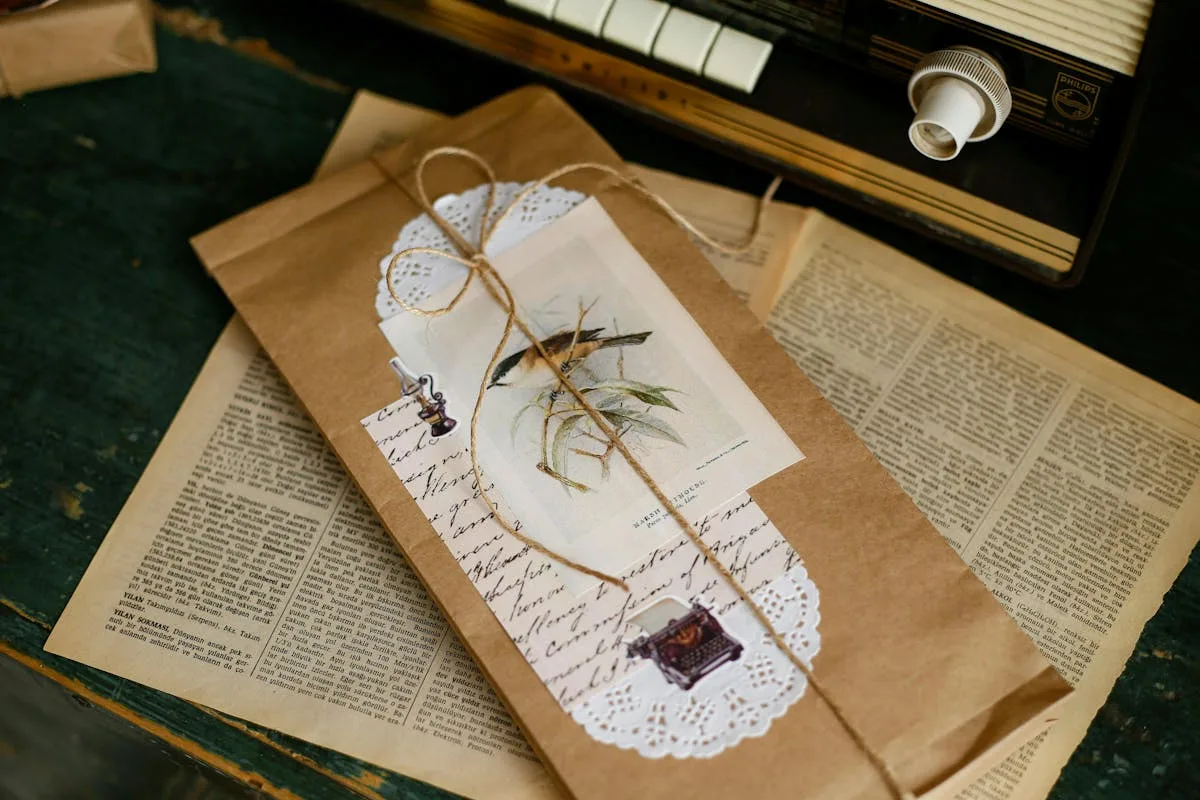
Envelope pocket. Glue an envelope (flap open) to
the page and tuck cards or tags inside.
Folded paper pocket. Fold the bottom third of a
page up and glue the sides to make a wide pocket.
Library card pocket. A small angled pocket holding
a journaling card to write on.
Cluster with a tuck spot. Layer paper and lace,
leaving a gap to slide a tag behind.
Belly band. A strip of paper across a folded insert
that holds it closed until you pull it out.
Make any page interactive in 30 seconds: Glue a
single envelope to the page, flap up, three sides down. That is a
pocket. Drop in a tag with a date or a one-line note. Interactive pages
are the ones people actually revisit, and this is the lowest-effort
version.
Themed junk journal spread
ideas
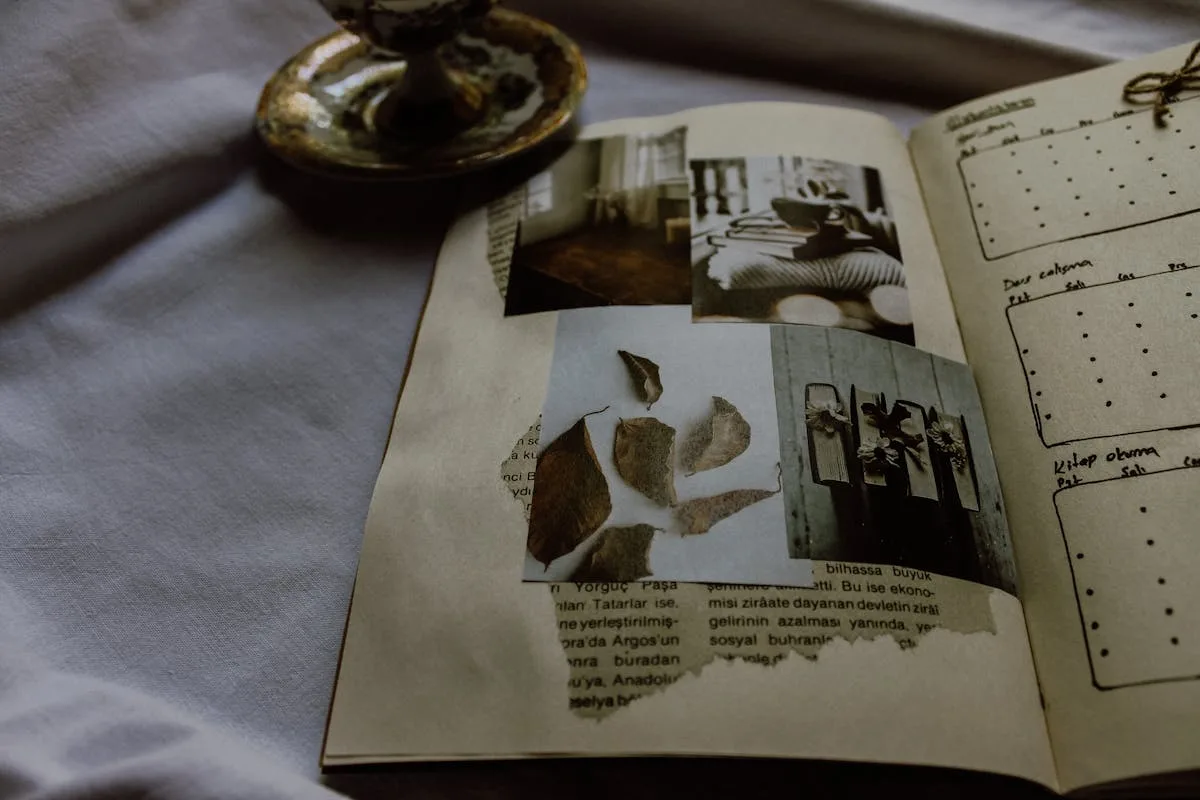
Themed spreads give a page direction by pulling everything around one
mood or subject, like travel, a season, or nature. A theme makes
choosing scraps easy because anything off-theme simply stays in the
box.
Popular themes:
Travel spread. Maps, ticket stubs, postcards, and a
small photo from one trip.
Seasonal pages. Autumn leaves and kraft tones, or
wintry blues and snippets of old carols.
Nature and botanical. Pressed flowers, seed
packets, and botanical printables.
Vintage memory page. One old photo, handwriting,
and a single keepsake, kept sparse.
Gothic or moody. Darker papers, old script, and
aged edges for a vintage-gothic feel.
Themed pages also make the best material to share as pins, since a
clear mood reads instantly in a thumbnail.
Interactive and fold-out
page ideas
Interactive pages use flaps, fold-outs, and dangles to add movement
and hidden space. They take a little more time but deliver the biggest
payoff, because they invite the reader to open and explore.
Ideas to try:
Flip-flaps. A small piece hinged on one edge that
lifts to reveal a photo or note underneath.
Gatefold spread. Two panels that open from the
center to a wider hidden page.
Waterfall of tags. A stack of tags layered so each
lifts to show the one below.
Dangles. Charms or tags on string hanging from the
page edge or spine.
Fold-out panorama. A long folded strip that opens
to a wide scene or timeline.
First page and intro page
ideas
Your first page sets the tone, so keep it low-pressure: a title, a
date, and one focal piece is plenty. Many junk journalers leave the very
first page simple on purpose and let the journal grow into itself.
Ideas to try:
Dated welcome page with a single quote or
intention.
“This book belongs to” page with a decorative
tag.
A color-test page where you try out your inks and
papers, which doubles as a reference.
How do you
decide what goes on a junk journal page?
Start with one anchor (a photo, a quote, or a single piece of
ephemera you love), then build a background and layers around it.
Working out from one focal point is far easier than trying to fill a
blank page all at once.
A reliable order: choose your anchor, lay a background, add two or
three layers, place the anchor, then finish with an aged edge and any
small embellishments. If a page feels unfinished, it usually needs
either an aged edge or one more layer behind the focal point.
Frequently
asked questions about junk journal pages
What do you put on junk
journal pages?
Layered paper backgrounds, ephemera (tickets, stamps, book pages),
photos, tags, pockets, and writing. Most pages combine a background, a
focal piece, and a pocket or tuck for keepsakes. There is no required
formula.
How do I make my
junk journal pages look good?
Layer at least two or three pieces, age the edges with ink, and build
around a single focal point. Crisp white edges and flat, single-layer
placement are what make a page look unfinished, so layering and aging
fix most pages instantly.
What is a junk journal
spread?
A spread is the two facing pages you see when the journal is open,
designed to work together as one scene. Treating both pages as a single
canvas, rather than two separate pages, gives a more cohesive look.
How many pages should
a junk journal have?
As many as you like. Many handmade junk journals have 20 to 40 pages,
but there is no rule. You can add signatures and pages as you go, so a
journal can grow over time.
What can I use for junk
journal pockets?
Envelopes, folded paper, library card pockets, and printable pocket
templates all work. Anything that creates a flap or gap to tuck a tag,
card, or keepsake into counts as a pocket.
Pick one idea and start a
page
You do not need all thirty ideas today. Pick one layered background
and one pocket, and build a single spread around a photo or piece of
ephemera you love. That one page will teach you more than any amount of
scrolling.
Want pages ready to go? Our free printable starter
kit includes pocket templates, tags, and vintage paper you can print and
build these spreads with. Sign up below and we will send it over.
Get free junk journal printables
New printables, page ideas, and paper craft tutorials, straight to your inbox.
To make a junk journal, you fold a small stack of paper into signatures, pierce three holes along the fold, and sew the signature to a flexible cover with a single length of thread. From there it is paper, glue, and a stack of receipts you forgot you saved. The whole bind takes about an…
Six classic letter folds for junk journaling: trifold, pamphlet, pocket, origami diamond, accordion, and twist. Plus the two-minute checks that keep a fold flat for years.
Manage Consent
To provide the best experiences, we use technologies like cookies to store and/or access device information. Consenting to these technologies will allow us to process data such as browsing behavior or unique IDs on this site. Not consenting or withdrawing consent, may adversely affect certain features and functions.
Functional
Always active
The technical storage or access is strictly necessary for the legitimate purpose of enabling the use of a specific service explicitly requested by the subscriber or user, or for the sole purpose of carrying out the transmission of a communication over an electronic communications network.
Preferences
The technical storage or access is necessary for the legitimate purpose of storing preferences that are not requested by the subscriber or user.
Statistics
The technical storage or access that is used exclusively for statistical purposes.The technical storage or access that is used exclusively for anonymous statistical purposes. Without a subpoena, voluntary compliance on the part of your Internet Service Provider, or additional records from a third party, information stored or retrieved for this purpose alone cannot usually be used to identify you.
Marketing
The technical storage or access is required to create user profiles to send advertising, or to track the user on a website or across several websites for similar marketing purposes.