You finished a spread last week and now one corner is lifting, the
focal piece is hanging by a thread, and you cannot work out what you did
wrong. Almost always, it is the glue. Most beginner journals fail at the
corners and the focal pieces, and the fix is one bottle of the right
adhesive, not three hours of technique drills.
The best glue for paper crafts depends on the job: a glue stick for
light paper, PVA for heavier pieces and covers, a tape runner for
photos, and matte medium for sealing. No single glue does it all, so a
small adhesive aisle is normal. None of the right ones are expensive,
and you only need one or two to start.
TL;DR. Light paper: glue stick. Anything heavier: a
bottle of PVA. Photos and flat scraps: tape runner. Sealing collage
pages: matte medium. If you buy one thing this week, buy PVA.
A good paper glue holds without wrinkling, dries clear, and is
acid-free so it does not yellow your work over time. Those three traits
matter more than price for anything you actually want to keep.
What to check:
Dries clear and flat. Avoid glues that dry shiny,
lumpy, or visible through thin paper.
Acid-free and lignin-free. Acid and lignin are what
yellow and weaken paper. Look for both on the label if you want the
journal to outlast the trend that inspired it.
Right strength for the job. Light paper needs
gentle tack; covers and fabric need real holding power.
Low moisture for thin paper. Wet glues buckle thin
sheets. Dry adhesives (sticks, runners) keep them flat.
Five glues cover almost every paper-craft job. The table sorts them
by which one wins where; the section under each row explains the
why.
Glue type
Light paper
Heavy ephemera
Fabric & covers
Photos
Dimensional pieces
PVA glue
Good (thin layer)
Best
Best
Okay
Okay for medium pieces
Glue stick
Best
Weak
No
Weak
No
Tape runner
Best
Weak
No
Best
No
Matte medium
Good (also seals)
Good
Okay
Okay
No
Tacky glue / foam dots
No (too thick)
Okay
Okay
No
Best
Most kits end up as PVA plus one dry option, with tacky glue or foam
dots brought in only when a page goes chunky enough to need them.
The best glues for
junk journaling, by job
The smartest way to choose is by task, since each glue shines
somewhere different.
Best all-rounder: PVA glue
Skip the “craft glue” aisle and look for PVA in the bookbinding
section instead. The same white glue bookbinders have used for a century
is also the most useful adhesive in a junk journal: it holds light and
heavy paper, fabric, and covers, and dries clear and flexible. Get an
acid-free, archival one. PVA handles maybe 80 percent of what a junk
journal throws at it, which is why it is the first thing to buy. Use
thin coats. Too much moisture and the page buckles before the glue has a
chance to set.
Best for
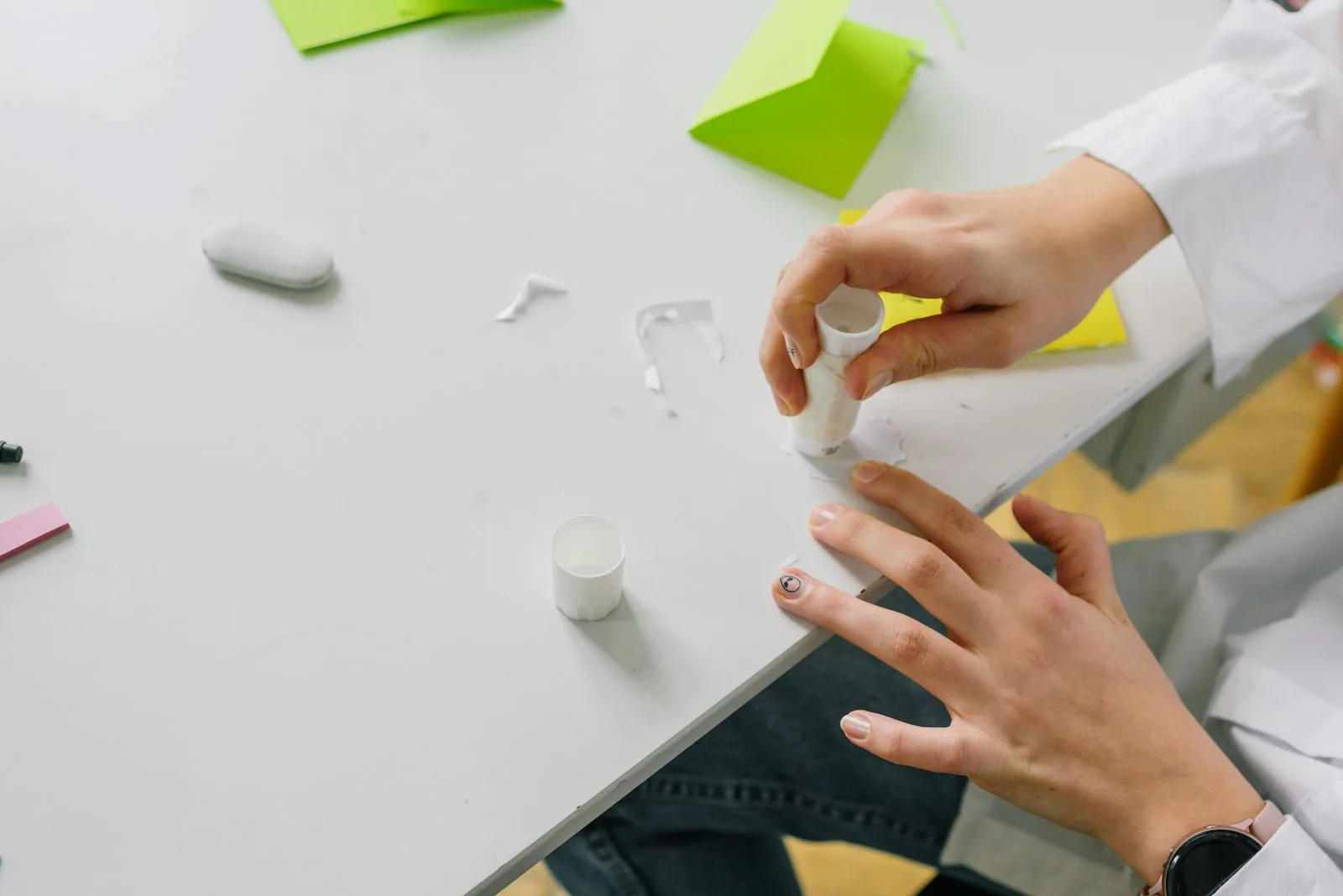
light paper and quick work: the glue stick
Most beginners use this without thinking of it as a junk journaling
tool, because the glue stick on the desk is the glue you actually pick
up. It is fast, low-moisture, and excellent for sticking down thin
paper, book pages, and small scraps without wrinkling. It is no match
for covers or heavy ephemera, but for everyday light collage it is the
easiest tool on the desk. Spend the extra dollar on a decent acid-free
one. The cheapest sticks dry out fast, and a week later your edges start
lifting like they have somewhere better to be.
Best for photos
and flat scraps: the tape runner
A tape runner lays down a dry strip of adhesive, so it adds zero
moisture and keeps photos and flat paper perfectly smooth. Fast,
mess-free, beautiful on memory pages. The downside is grip: it does not
hold heavy or textured pieces, so keep it in the flat-and-light
lane.
Best for sealing and
collage: matte medium
Matte medium glues and seals at the same time. You adhere a piece and
protect it with a clear matte finish in one coat. It is great for
collage-heavy pages and for sealing delicate ephemera. It is wet like
PVA, so use thin coats and dry under a little weight, or your spread
will look wavy by morning.
Best for
dimensional pieces: tacky glue or foam dots
For chunky bits (buttons, charms, thick die cuts), thick tacky glue
or foam dots hold what flat glues cannot. Foam dots also lift the piece
off the page, which adds the kind of dimension you cannot fake with a
flat adhesive.
If you only buy one thing. A bottle of acid-free PVA
glue, the kind sold for bookbinding. It covers the widest range of junk
journaling jobs and quietly fixes the single most common beginner
complaint (pieces that curl and peel a week after you stick them down).
A glue stick is the nice-to-have on top of it, not the swap-in.
Why glue choice
matters for a journal you keep
Paper aging is a slow chemistry experiment, and your glue is part of
it. Wood-pulp paper is naturally acidic and full of lignin, the compound
that turns old newsprint that sad shade of brown. Over years, the acid
(in the paper, in the wrong adhesive) eats the cellulose fibres and the
page goes brittle. The international standard for permanent paper, ISO
9706, sets the chemistry that prevents this: neutral or slightly
alkaline pH, a calcium carbonate buffer, low lignin. The Library of
Congress uses the same logic on adhesives in its preservation
guidelines, which is why PVA bookbinding glue and acid-free papers are
the default in archive work.
For a journal you want to flip through in ten years, the label
actually matters. For a quick play journal you will use up in a month,
it does not. Either way, now you know what that little “acid-free,
lignin-free” line is really telling you.
Frequently asked questions
What is the best glue
for junk journaling?
Acid-free PVA glue is the best all-rounder because it holds light
paper, heavy paper, fabric, and covers, and dries clear and flexible.
Pair it with a glue stick for fast, light work.
Is a glue stick good
enough on its own?
Honestly, only if you are sticking thin paper to thin paper and
nothing else. The moment you add a fabric cover, a heavy magazine page,
or an envelope you want to use as a pocket, the stick gives up. Keep it
for everyday collage and let PVA do the structural work.
Can you use Mod Podge
for junk journaling?
Yes, but treat it as a sealer first and a glue second. Mod Podge
(matte) is essentially a matte medium: great for sealing pages, collage,
and decoupage; weaker than straight PVA for plain sticking. Use it when
you want the top-coat finish too.
Is PVA glue acid-free?
Bookbinding-grade PVA almost always is; school-glue PVA usually is
not.
Is washi tape
strong enough to replace glue?
No, it is decorative.
What glues should
you avoid for paper crafts?
Avoid rubber cement, hot glue, and super glue for most paper work.
They yellow, bleed, dry lumpy, or warp thin paper. They have their uses
elsewhere, just not inside a journal you want to keep.
The shortlist of what to skip:
Rubber cement. The solvent evaporates and the bond
gives up within a couple of years, plus the residue yellows badly.
Beautiful in 1995, sad now.
Hot glue. Too thick and lumpy for flat paper. It
works on chunky embellishments where the bulk hides it, but on a regular
spread the heat warps thin sheets and the glob shows through every layer
above it.
Super glue (cyanoacrylate). Wrong tack for porous
paper, can stain and bloom (that ugly white haze around the bond), and
bonds skin alarmingly fast. Save it for plastic.
Cheap dollar-store white glue. Often too wet and
not acid-free, so it buckles in the moment and yellows later.
Office-grade masking and cellophane tape. The
rubber-based adhesives go brittle and stain after a year or two. Fine
for a moving box, wrong for a journal.
How do you glue paper
without wrinkles?
Use a thin, even layer of a low-moisture adhesive and smooth from the
centre out. Wrinkles come from too much wet glue soaking thin paper, so
the fix is always less moisture, not more glue.
A few habits that help: glue stick or tape runner for thin paper, PVA
sparingly when you need strength, smooth each piece with a bone folder
or just your hand from the middle outward, and dry wet-glued pages under
a book overnight. For the layouts you will be gluing, see junk journal page ideas.
Build your adhesive aisle
You do not need a shelf of adhesives. A bottle of acid-free PVA, one
glue stick, a tape runner if you use photos, and that is the whole
aisle. Match the glue to the job, smooth from the centre out, and your
next page goes from glued-down to genuinely stuck-down: the kind that
survives the journal living in a tote bag for a year.
Want to practice? Our free printable starter kit
gives you paper to glue and layer with, so you can test your adhesives
on real pages. Sign up below and we will send it over.
Get free junk journal printables
New printables, page ideas, and paper craft tutorials, straight to your inbox.
A junk journal example is a finished or in-progress book you can look at to see how the supplies, pages, and cover actually fit together. We have grouped the most useful types below, with a short walkthrough of what each one looks like inside, so you can find the version closest to the journal you…
To make a junk journal, you fold a small stack of paper into signatures, pierce three holes along the fold, and sew the signature to a flexible cover with a single length of thread. From there it is paper, glue, and a stack of receipts you forgot you saved. The whole bind takes about an…
Manage Consent
To provide the best experiences, we use technologies like cookies to store and/or access device information. Consenting to these technologies will allow us to process data such as browsing behavior or unique IDs on this site. Not consenting or withdrawing consent, may adversely affect certain features and functions.
Functional
Always active
The technical storage or access is strictly necessary for the legitimate purpose of enabling the use of a specific service explicitly requested by the subscriber or user, or for the sole purpose of carrying out the transmission of a communication over an electronic communications network.
Preferences
The technical storage or access is necessary for the legitimate purpose of storing preferences that are not requested by the subscriber or user.
Statistics
The technical storage or access that is used exclusively for statistical purposes.The technical storage or access that is used exclusively for anonymous statistical purposes. Without a subpoena, voluntary compliance on the part of your Internet Service Provider, or additional records from a third party, information stored or retrieved for this purpose alone cannot usually be used to identify you.
Marketing
The technical storage or access is required to create user profiles to send advertising, or to track the user on a website or across several websites for similar marketing purposes.