Nobody warns you that homeschooling is part teaching and part air-traffic control. Three kids, four subjects each, a co-op on Tuesdays, a library run on Thursdays, a curriculum that assumes you have a syllabus, and somewhere a state requirement to log the days you actually did school. The teaching you can do. It is the tracking that quietly eats your evenings.
A homeschool planner is the answer, and the printable kind is better than a bound one for a simple reason: every family’s homeschool looks different, so a one-size planner always has pages you do not need and is missing the ones you do. Print the sheets that match your house and skip the rest. Below are the homeschool planner printables a teaching parent genuinely uses, grouped by the job they do, with the free starter pack we built for Craft Wren at the top.
The short version: Start with a weekly lesson plan grid and a simple attendance log, since those two cover most record-keeping needs. Add a year-at-a-glance for the big dates, a reading log if you have a reader, and a grade or progress tracker only if your state asks for one. Print, test for a week, then bind the keepers in a binder.
Why printable homeschool planners beat the store-bought kind
A boxed homeschool planner is built for an imaginary average family, which means it is wrong for yours in some specific way. Too few subject columns, or too many. A grading section you do not use because your kids are in kindergarten, or none when your high-schooler needs transcripts. Printables let you assemble the planner your actual house runs on.
Three reasons the printable version wins for homeschoolers in particular:
You match the pages to your kids. One column per subject for a single child, six columns for a full house, a separate sheet per kid if their schedules diverge. A printable bends; a bound planner does not.
You reprint when the year changes. Switched curriculum in January? New co-op schedule? Print the updated layout instead of crossing out and squeezing into a planner built in August.
It scales with your family for free. Add a child, print another set of pages. No buying a second forty-dollar planner because the first only had room for two students.
If you want the planner to be a keepsake as well as a tool, the printed pages drop straight into a handmade cover. Our how to make a junk journal guide covers the binding if you would rather sew a cover than buy a binder, which is a lovely end-of-year memento of the school year.
The homeschool planner pages worth printing
There are about six categories of homeschool printable that do real work. The free versions are good enough that the paid premium bundles are mostly charging for a cohesive color scheme.
1. Weekly lesson plan grid (the workhorse)
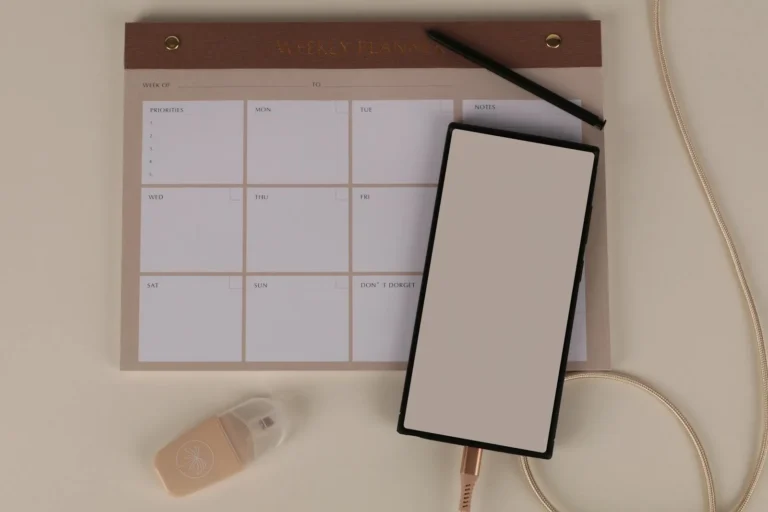
The single most-used page in any homeschool planner. A weekly grid with days across the top and subjects down the side, or the reverse, where you write what each child is doing in each subject this week. This one sheet runs your whole teaching week.
Pick the orientation that matches your house. One child with many subjects suits subjects-down-the-side; several children doing the same subjects suits a kid-per-column layout with a shared subject list. Print a few weeks ahead, not the whole year, since plans always shift.
2. Attendance and days-logged sheet
The page that keeps you compliant. Many states require a count of instructional days, and a simple printable attendance log, one box per day with space to note the date, handles it without a spreadsheet. Mark the day, and at the end of the year you have your count ready.
Keep this one even if your state is relaxed about records. A days-logged sheet is also the honest mirror that tells you whether the light weeks are quietly outnumbering the full ones, which is worth knowing no matter the law where you live.
3. Year-at-a-glance calendar
A single page showing the whole school year catches the things a weekly view misses: co-op start dates, testing windows, the week you are traveling, the holidays you are taking. Pin it where the family can see it and plan the weekly grids around it.
Buy this, not that: Skip any homeschool printable pack over ten dollars that is mostly decorative cover pages and motivational quotes. The pages that do work, the lesson grid and the attendance log, are plain by nature, and the prettiest pack in the world will not log a single school day for you. Spend the money on a sturdy binder and a good pen instead.
4. Reading and book logs
If you have a reader in the house, a reading log is the easiest win in the planner. One line per book, with title, author, and a date finished, turns the year’s reading into a list everyone is a little proud of by spring. For younger kids, a version with a row of stars to color works better than a date column.
For younger kids especially, a finished reading log is the kind of thing they want to show off, which makes it one of the easier wins to keep them invested in the school year.
5. Grade and progress trackers
The most-overbuilt category, and the one to add only if you need it. A grade tracker matters for older students and transcript-keeping states; it is pure busywork for a kindergartner. Print a simple subject-by-subject progress sheet for the kids who need a record, and leave it out entirely for the ones who do not.
When you do need one, look for a layout that tracks progress against goals rather than just averaging numbers, since the point of a homeschool record is showing growth, not assigning a class rank.
6. Curriculum and supply planners
Behind-the-scenes pages that save you in August: a curriculum-by-subject sheet listing what you are using, a supply checklist for the year’s materials, and a budget page if you are buying curriculum on a tight number. Print these once a year, fill them at planning time, and refer back when you reorder.
How to put a homeschool planner together
Loose lesson sheets get lost between the couch cushions by week two. Bind them so the planner has one home:
A three-ring binder with dividers. The homeschool standard. A tab per child or per subject, lesson grids in front, logs and trackers in back. A one-inch binder holds a full year for a small family.
A discbound system. Worth it if you reshuffle weekly and want to move completed pages to the back without opening rings.
A handmade cover. Bind the year’s pages into a sewn or glued cover for a planner that becomes a keepsake. The junk journal supplies guide has the paper and binding basics.
Print one week of each page type on regular paper first and live with it for a few days. The grid that looked roomy on screen is sometimes too tight once you are writing four kids’ math assignments into it. Once you know the layout works, reprint the keepers and build the binder around them.
Where to find free homeschool planner printables
Free homeschool printables live on veteran homeschool-mom blogs, Pinterest, Etsy free listings, and craft-printable libraries. Sort the real ones from the filler:
Established homeschool blogs. The best source by far. A parent who has homeschooled for a decade and offers their planner as a newsletter download has tested those pages on real kids. Sign up, grab the PDF, unsubscribe if the newsletter is not for you.
Printable craft libraries like Creative Fabrica. Carry large planner and education printable collections, with a free monthly allowance before any paid tier, which is handy for matching a whole planner to one look.
Pinterest, with caution. Favor pins that link to a real homeschool blog over anonymous template pins, since half the rest lead to dead pages.
Canva. Free homeschool planner templates you can customize for your exact subject list and print at home.
Skip the AI-generated PDF sites with no author and the downloads that ask for a phone number to hand over one page. Neither respects your time.
Frequently asked questions about homeschool planner printables
Are homeschool planner printables free?
Most useful ones are free, often as email-signup downloads from experienced homeschool blogs or through the free monthly allowance on printable libraries. Premium bundles exist in the five to twenty dollar range, but the free tier covers everything a teaching parent needs. A free pack plus a binder outperforms most paid “complete homeschool planner” sets.
What pages do I need in a homeschool planner?
A weekly lesson plan grid and an attendance log cover the essentials for most families. Add a year-at-a-glance calendar for big dates, a reading log if you have a reader, and a grade tracker only if your state requires records. Build from those rather than printing every page type at once.
How do I track homeschool attendance with a printable?
Use a simple days-logged sheet with one box per school day and space for the date, and mark each day you do school. At the end of the year you have a total ready for any state reporting. Keep the sheet even in relaxed states, since the running total is also the simplest way to see whether you are doing as much school as you think you are.
Can I print homeschool planner pages at home?
Yes. A home printer on letter-size paper handles every page in this guide. Print a test week on regular paper to confirm the grid fits your handwriting and your number of kids, then reprint the keepers on a heavier stock so a year of handling does not wear them out.
How do I organize a homeschool planner for multiple kids?
Use a binder with a tabbed divider per child, or a shared weekly grid with one column per kid if their subjects overlap. Printables make this easy, since you simply print another set of pages for each child rather than buying a second planner. Keep shared pages, like the year calendar, in their own section up front.
Build the planner your homeschool actually runs on
The pages that matter in a homeschool planner are the unglamorous ones, the lesson grid and the attendance log that quietly keep you on track and on the right side of your state’s rules. Print those, test them for a week, bind the keepers, and leave the decorative cover pages in someone else’s planner.
For the wider menu of planner pages beyond homeschooling, our printable planner pages guide sorts every type by what it does. And if you are juggling a big event on top of the school year, the printable wedding planner guide uses the same binder-and-free-printables approach for a wedding.
Want the Craft Wren free homeschool starter pack? A weekly lesson grid, an attendance log, a year-at-a-glance calendar, and a reading log, in one clean matched layout. Print at home, drop them in a binder, and start the term ready. Sign up below and we will send it over.
Get free junk journal printables
New printables, page ideas, and paper craft tutorials, straight to your inbox.
Free fitness planner printables worth printing: weekly workout log, food tracker, progress sheet, habit tracker, and goal-setting pages, plus where to find them free.
Free student planner printables that survive a term: weekly class schedule, assignment tracker, semester-at-a-glance, study planner, and where to find them free.
Free printable planner pages worth printing, sorted by what they do: weekly, daily, monthly, to-do, and trackers, plus where to find them and how to bind them.
Free cleaning planner printables worth printing, grouped by the job they do: weekly checklist, daily zone sheet, deep-clean list, chore chart, and where to find them free.
Manage Consent
To provide the best experiences, we use technologies like cookies to store and/or access device information. Consenting to these technologies will allow us to process data such as browsing behavior or unique IDs on this site. Not consenting or withdrawing consent, may adversely affect certain features and functions.
Functional
Always active
The technical storage or access is strictly necessary for the legitimate purpose of enabling the use of a specific service explicitly requested by the subscriber or user, or for the sole purpose of carrying out the transmission of a communication over an electronic communications network.
Preferences
The technical storage or access is necessary for the legitimate purpose of storing preferences that are not requested by the subscriber or user.
Statistics
The technical storage or access that is used exclusively for statistical purposes.The technical storage or access that is used exclusively for anonymous statistical purposes. Without a subpoena, voluntary compliance on the part of your Internet Service Provider, or additional records from a third party, information stored or retrieved for this purpose alone cannot usually be used to identify you.
Marketing
The technical storage or access is required to create user profiles to send advertising, or to track the user on a website or across several websites for similar marketing purposes.