The reason most beginners stall is not the craft. It is the spell the
empty book casts the first time they sit down. They wait to learn the
“right” way, then never quite start. There is no right way. A junk
journal is a personal book of saved paper, and the only way to do it
wrong is to not start.
This guide is built to break that spell. You get a handful of small,
finishable projects you can complete in one sitting, a short list of
mistakes that frustrate most beginners, and a quick read on how often
you actually need to sit down for it to become a habit. No supply hauls,
no technique drills, no waiting until your kit is “ready.”
TL;DR. Notebook, glue stick, scissors, saved paper.
Make the collaged background page first; it takes ten minutes and breaks
the spell. Avoid buying a haul before you make page one. Aim for a small
page every few days, not a marathon every other Sunday.
Junk journaling suits beginners because the cost of failure is
roughly zero. You arrange and glue paper you already own, not paint or
draw, so there is no blank-canvas pressure and no expensive mistake to
make. A page that looks bad gets a second layer on top of it; problem
solved.
A few things that make it easier than most crafts to start:
No drawing required. You collage existing
materials, not create from scratch.
No real cost. Your raw materials are saved scraps
and a glue stick.
Crooked is the style. Layered and imperfect is the
look most people are actually trying to copy.
Pages finish fast. A spread comes together in
minutes, so the payoff loop is short.
For the broader picture of what the craft is, our complete guide to junk journaling covers
the whole thing. This page stays focused on your first few pages.
What a beginner actually
needs
A beginner needs four things: a book to work in, a glue stick,
scissors, and a small pile of saved paper. That is the entire starter
kit, and you can gather it from around the house for free.
The short list:
A cheap notebook or composition book (or an old book to
repurpose).
A glue stick, plus PVA glue if you have it.
Scissors.
Saved paper: envelopes, packaging, book pages, magazine cutouts,
tickets.
Resist the urge to shop first, and we mean that as a serious
recommendation, not a polite suggestion. The supply haul is the most
reliable way to never make page one. For what is worth buying later and
where to find it cheap, see the junk
journal supplies list, but none of it is needed today. If you are
also unsure what kind of book to start in, the best journal for junk
journaling walks through the main options.
Easy starter
projects (pick one and do it today)
The best first projects are small and finishable, not ambitious. Five
projects below, ordered from easiest to most rewarding once you have a
few pages under your belt. The table compares them at a glance; details
follow.
Project
Time
Difficulty
Why it works
Collaged background page
10 min
Easy
First page done, blank book gone
One-color page
15 min
Easy
Looks intentional with zero planning
Pocket page
20 min
Easy
Your first interactive page
“Today” page
5 min
Easiest
Memory-keeping at its simplest
Quote page
15 min
Easy-medium
Builds your eye for composition
Start here: the
collaged background page
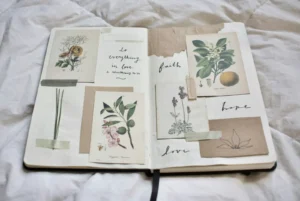
If you only do one project today, this is it. Glue a book page down
as your base, layer two patterned scraps on top, and stick one focal
piece (a photo, a stamp, a ticket) in the middle. Done. That is a real
page, finished in ten minutes, and it does the job nothing else does: it
puts something inside the book so the blankness stops being the thing
you are staring at.
When two
colors feel like too many: the one-color page
Pull only scraps in a single color (browns, blues, whatever you have
the most of) and layer them. The thing that surprises beginners is how
intentional this looks despite needing no planning. The colour limit
does the design work for you, and you cannot really get it wrong.
Make it open up: the pocket
page
Glue an envelope to the page (flap up), and tuck a tag or note
inside. That is the whole project. The first time you flip past it and
the flap moves, you understand why people love this craft and stop
thinking of it as collage. Pockets turn a flat page into a small
object.
Five-minute version: the
“today” page
Glue down one thing from your day (a receipt, a wrapper, a ticket
stub) and write the date next to it. That is a page. The “today” page is
the project that quietly turns junk journaling into a habit, because it
takes less time than scrolling Instagram and it leaves something
behind.
Build your eye: the quote
page
Print or write out a quote you like, lay a soft background behind it,
and frame it with a torn paper edge. This is the first project where
composition starts to matter, which is exactly why it is fifth and not
first. You will look at the finished page and notice what you would do
differently next time, and that noticing is how style starts.
Do one thing this week. Make the collaged background
page. Book page, two scraps, one focal piece, glued down. Ten minutes.
Tomorrow you will want to make another, and that is how the habit starts
and the empty book stops being the thing in the way.
Mistakes that stall
beginners
The mistakes that frustrate beginners are about pressure and
overbuying, not technique. Skip these four and your first journal will
be a pleasure instead of a chore.
Buying a haul before making a page. Stuff does not
teach you your style; pages do. Start with what you already have.
Chasing perfect. Layered and imperfect is the look.
A crooked, slightly messy page is a good page; a “perfect” beginner page
usually looks stiff.
Saving your favourite paper. That pretty scrap is
meant to be used. Use it now, not “someday.” Someday is how a stash
becomes a museum.
Comparing your page one to an expert’s year three.
Every journaler has an ugly first book. Yours is supposed to exist.
The habit
math: how often you actually need to do this
Most people massively overestimate how much time a junk journal needs
and then quit when their “Saturday all to myself” never happens. The
math is gentler than that. A small page takes ten to twenty minutes, a
more layered spread thirty to forty-five. A page every three or four
days fills a starter journal in roughly two months, which is faster than
most people expect.
What actually matters is keeping your supplies in arm’s reach, not a
free afternoon. In our experience the biggest difference is whether your
book, glue, and scrap pile live somewhere you pass by, not somewhere you
have to set up. A drawer next to the couch beats a tidy craft shelf in
the spare room every time.
Short, frequent sessions also beat rare marathons, and the reason, we
think, is that each session ends with a finished page. A two-hour
session ending with one elaborate spread can feel like worse value than
four ten-minute sessions ending with four little pages, even though the
time spent is the same. The brain likes complete things.
Frequently asked questions
Is junk journaling easy
for beginners?
Yes. You arrange existing paper instead of drawing or painting, so
there is no skill test and no wrong result, and beginners get satisfying
pages from day one.
What is
the easiest junk journal project for a beginner?
The collaged background page. Glue a book page down, add two scraps,
place one focal piece. Five minutes, no skill, real page.
Do I need
expensive supplies to start junk journaling?
No.
What should a
beginner put in a junk journal?
Saved paper and ephemera: envelopes, book pages, tickets, packaging,
magazine cutouts, photos, and tags. Some beginners also add written
notes, quotes, or a short diary entry. Anything flat and meaningful
works, and “meaningful” can mean as small as a coffee receipt from a
good morning.
How do I keep a
junk journaling habit going?
Keep your supplies somewhere you walk past daily and aim for a small
page every few days, not a long session every other weekend. Quick wins
build the habit faster than waiting for a free afternoon.
Make your first page this
week
Junk journaling rewards starting, not planning. Grab a notebook,
three scraps you like, and a glue stick. Make the collaged background
page above. That single page is the whole craft in miniature, and it is
the best first step you can take.
Want an easy head start? Our free printable starter
kit gives you vintage paper, tags, and pockets to build your first pages
with, no stash required. Sign up below and we will send it your way.
Get free junk journal printables
New printables, page ideas, and paper craft tutorials, straight to your inbox.
To make a junk journal, you fold a small stack of paper into signatures, pierce three holes along the fold, and sew the signature to a flexible cover with a single length of thread. From there it is paper, glue, and a stack of receipts you forgot you saved. The whole bind takes about an…
This post contains affiliate links. We may earn a commission when you download a freebie or buy a subscription on Creative Fabrica, at no extra cost to you. Junk journal ephemera is the loose category of paper, fabric, and small flat objects that get glued, tucked, or layered into junk journals. It covers vintage paper,…
New to junk journaling? Learn what a junk journal is, what you need to start, and how to make your first pages using things you already have.
Manage Consent
To provide the best experiences, we use technologies like cookies to store and/or access device information. Consenting to these technologies will allow us to process data such as browsing behavior or unique IDs on this site. Not consenting or withdrawing consent, may adversely affect certain features and functions.
Functional
Always active
The technical storage or access is strictly necessary for the legitimate purpose of enabling the use of a specific service explicitly requested by the subscriber or user, or for the sole purpose of carrying out the transmission of a communication over an electronic communications network.
Preferences
The technical storage or access is necessary for the legitimate purpose of storing preferences that are not requested by the subscriber or user.
Statistics
The technical storage or access that is used exclusively for statistical purposes.The technical storage or access that is used exclusively for anonymous statistical purposes. Without a subpoena, voluntary compliance on the part of your Internet Service Provider, or additional records from a third party, information stored or retrieved for this purpose alone cannot usually be used to identify you.
Marketing
The technical storage or access is required to create user profiles to send advertising, or to track the user on a website or across several websites for similar marketing purposes.