
Vision Boards for Manifesting: How They Actually Work (and When They Don’t)
Vision boards work when they make you act differently, not when you stare at them. The collage is the easy part. The thing that turns a poster of dream apartments into a one-bedroom lease in March is a small daily change in what you notice, what you say yes to, and what you decide is normal for you.
Manifesting is one of those words that arrives with a lot of baggage. Half the internet pitches it like a magic spell, the other half eye-rolls it into oblivion. Both miss the point. There is a quiet, well-studied middle of this conversation where setting concrete visual goals does measurably shift behavior, and a vision board is one of the cheapest, oldest tools for doing that. We will get into why, what to put on it, and the part most people skip.
You will not find affirmations to “raise your vibration” here, and you will not find a debunk either. You will find the part that actually moves.
The short version: A vision board makes manifesting work by giving you a daily, visual reminder of specific outcomes you have committed to, which research links to better goal pursuit. To make yours actually work, get specific (not “happy life”, but “$10k saved by December”), pair the image with a small daily action, and put it where you see it every morning. The board does not deliver the goal. It nudges you toward the small choices that do.
What does it mean to manifest with a vision board?
Manifesting with a vision board means using a curated collection of images, words, and goals as a visual cue to keep your attention on outcomes you have chosen, so that your daily decisions trend toward them. The board is a memory tool and a focus tool, not a wish-fulfillment machine. The point is consistency of attention, not the secret hand-wave of the universe.
People use the term “manifesting” three different ways, and it helps to separate them:
- Spiritual/Law-of-Attraction sense. The belief that focused thought attracts matching outcomes. You will find a lot of this on Pinterest and TikTok. It is the version that gets dunked on.
- Psychological sense. Using mental imagery and committed goals to influence the behaviors that produce outcomes. There is real research behind this version, and that is the one we will lean on.
- Practical sense. Just keeping your goals visible so you do not forget them in the noise of daily life. Not mystical at all.
A vision board can hold all three at once for the person who makes it, and that is fine. The thing that matters is whether the board changes what you do day to day. If it does, the label you put on it is your business.
Do vision boards actually work?
Vision boards work when they are paired with concrete goals and follow-up action, and they do not work when they are used purely as wish-collages with no plan behind them. The split lines up with what goal-setting research has been saying for several decades.
The piece of research worth knowing about is mental contrasting, a framework developed by psychologist Gabriele Oettingen and her colleagues. Across multiple published studies, Oettingen found that simply visualizing a positive future outcome (what most vision boards do) had a small or sometimes negative effect on actually achieving the outcome, because pure positive fantasy partly drains the motivational energy you would have used to pursue it. The fix she proposes, known by the acronym WOOP (Wish, Outcome, Obstacle, Plan), pairs the future image with a clear-eyed look at what is likely to get in the way, and a specific if-then plan to handle it.
The implication for vision boards is awkward but useful: imagery alone is the weakest version of the practice. Imagery plus specific goals plus a plan for the obstacle is the version with real evidence behind it. Most vision board tutorials online stop at the first part. We are going to do all three on yours.
Older work supports the same idea from a different angle. Edwin Locke and Gary Latham’s goal-setting research, summarized in their book A Theory of Goal Setting and Task Performance, found that specific, difficult goals consistently outperform vague ones like “do your best.” A vision board with vague aspiration (“be happy”) behaves like the “do your best” condition. A vision board with a $10,000 emergency-fund target, a specific apartment neighborhood, or a named role at a named company behaves like the goal-setting condition. The difference shows up in outcomes.
So the answer to “do vision boards work” is: yes, if you build one that does the work the research describes. A poster of pretty photos is not that.
How to use a vision board for manifesting (5 steps that actually move the needle)
Each step below is the practical hook for one of the research bits above. None of it requires you to believe in anything.
- Pick three to five specific goals, not vague themes. Not “love” but “go on two coffee dates a month and message three people on Hinge a week.” Not “money” but “$15,000 saved by December 2026.” Specific goals are what the research actually supports.
- Choose one image per goal that you will recognize at a glance. A literal photo of the apartment building you want to live in, the role on a real LinkedIn page, the gym you want to walk into. Not a mood, a thing. Cluttered boards lose this; eight images of “freedom” mean nothing.
- Write the if-then plan on the board. Yes, on the board. A small index card or sticky note for each goal. “If it is Wednesday morning, then I will send two outreach emails before I open Slack.” This is the WOOP part most people skip.
- Look at it once a day, briefly, in a fixed place. Hang it where you do something habitual: by the coffee maker, beside the mirror you brush your teeth at, behind the desk. Thirty seconds counts. Long stares are not the point.
- Update it every quarter. Take a phone photo before you change anything, so you have a record. Then swap out what changed. A board that stops matching your year is a board you stop seeing.
If you want a step-by-step on the physical build, we have a vision board supplies list that walks through what to buy, what to skip, and how to do it for free.
What to put on a vision board for manifesting

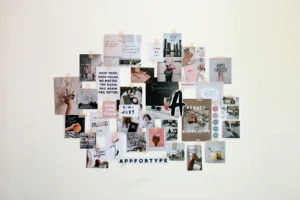
Put four kinds of things on a vision board: specific outcomes, specific identity cues, specific actions, and quotes that reframe you out of a stuck state. Notice what is doing the work in that sentence. Specific.
A working board usually mixes:
- Specific outcome images. The lease, the bank balance, the partner, the school. Photos of the actual thing, not metaphors for the thing.
- Identity cues. A photo of someone with a body you want to train toward; a working environment that matches the role; a closet that matches how you want to dress. These work because they prime small daily choices in the direction of the identity.
- Action prompts. A weekly running schedule, a savings tracker, a list of three people to message. Boards with no action prompts drift into pure dream-pile.
- Anchor quotes. One to three lines of text that reset you when the day goes sideways. For a starter pack of these, see our vision board quotes printable, which you can print and glue straight on. For money goals specifically, our money manifestation affirmations set sorts 40 by situation.
What to leave off: anything that looks like a general “good life.” Vague sunsets, abstract beach photos, “thrive” lettering. They feel good and do nothing. The brain skims them like any other piece of pretty content on a feed.
Common mistakes that make a vision board feel useless
Five mistakes turn up over and over in boards that quietly stop working:
- Too many goals. Eighteen images of eighteen things means none of them is the priority. Three to five is plenty.
- Vague aspirations. “Joy,” “abundance,” “growth.” Replace each with a sentence that names a number, a date, or a person.
- Hung where you never look. The inside of a closet door does nothing. The wall you pass at 7am does.
- No obstacle plan. This is the WOOP part. If you have not named the thing most likely to derail you, the board cannot help you when that thing shows up.
- Built once and never touched. A board frozen in January has nothing to say to you in October. A five-minute quarterly refresh keeps it alive.
If you want a side-by-side breakdown of pre-built bundles you can start from, we cover those in our vision board kits roundup. For the supplies route from scratch, the vision board supplies list has the four-item starter kit.
How often should you look at your vision board?
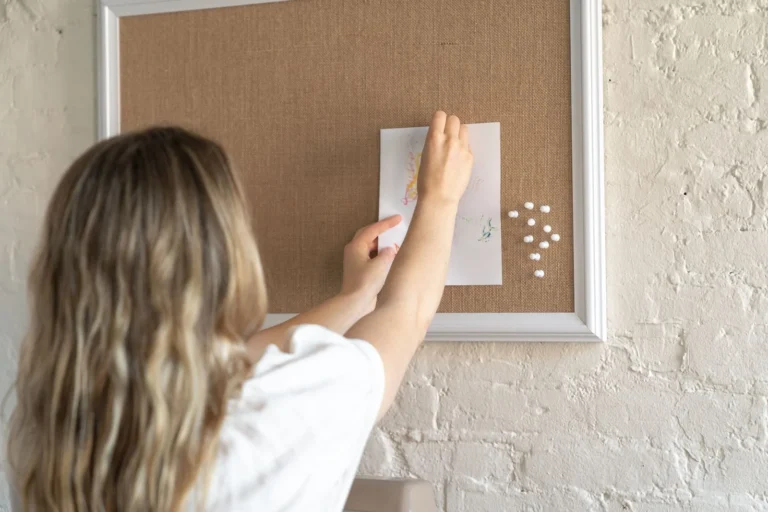
Look at it briefly every day, in the same place and time, rather than for long sessions once a week. Habit-formation research consistently finds that short repeated cues attached to existing routines (coffee, brushing teeth, opening the laptop) stick better than scheduled “intention sessions.” A glance counts. A glance every morning for a year is a lot of glances.
The other thing the daily glance does is keep the board in your peripheral attention even when you are not looking at it. You walk past it on your way to the kitchen. You catch your kid drawing under it. Your phone-photo of the board ends up in your camera roll. Repetition is the whole game.
Frequently asked questions about vision boards for manifesting
What is the difference between a vision board and a manifestation board?
There is no real difference. “Manifestation board” and “vision board” are used interchangeably online, with “manifestation board” leaning a bit more into Law-of-Attraction language. Both refer to the same physical or digital collage of goals, images, and words. Call it whichever feels right to you.
Can I make a vision board without believing in manifestation?
Absolutely. The goal-setting and habit-formation parts work whether or not you buy into anything spiritual. Plenty of people make purely practical vision boards as planning tools. The board does not care what you believe; the daily attention it gives your goals does the lifting.
How long does it take for a vision board to work?
Most people see small behavior shifts within a few weeks, and tangible outcomes on three-to-twelve-month horizons, depending on the size of the goal. A vision board is not a delivery service. It is a slow attentional nudge. Goals that need months to play out (career moves, savings targets) match the tool best; goals that need a same-week action do not really need a board.
Should I tell people about my vision board?
Mixed evidence. Some research suggests that publicly sharing goals can lower your motivation to pursue them, because you get the social reward of announcement without doing the work. Other studies find the opposite when sharing creates accountability with someone who will follow up. The safe default is to share the board only with people who will check in on you, and to keep it private otherwise.
Where should I put my vision board so it actually works?
Hang it at eye level in a spot you pass every morning: bedroom wall, beside a mirror, by the coffee setup, behind your desk. The most important rule is that it should be impossible to miss as part of an existing daily routine. Phone lock screens and laptop wallpapers count as digital versions of the same idea.
Build a quiet, working one this week
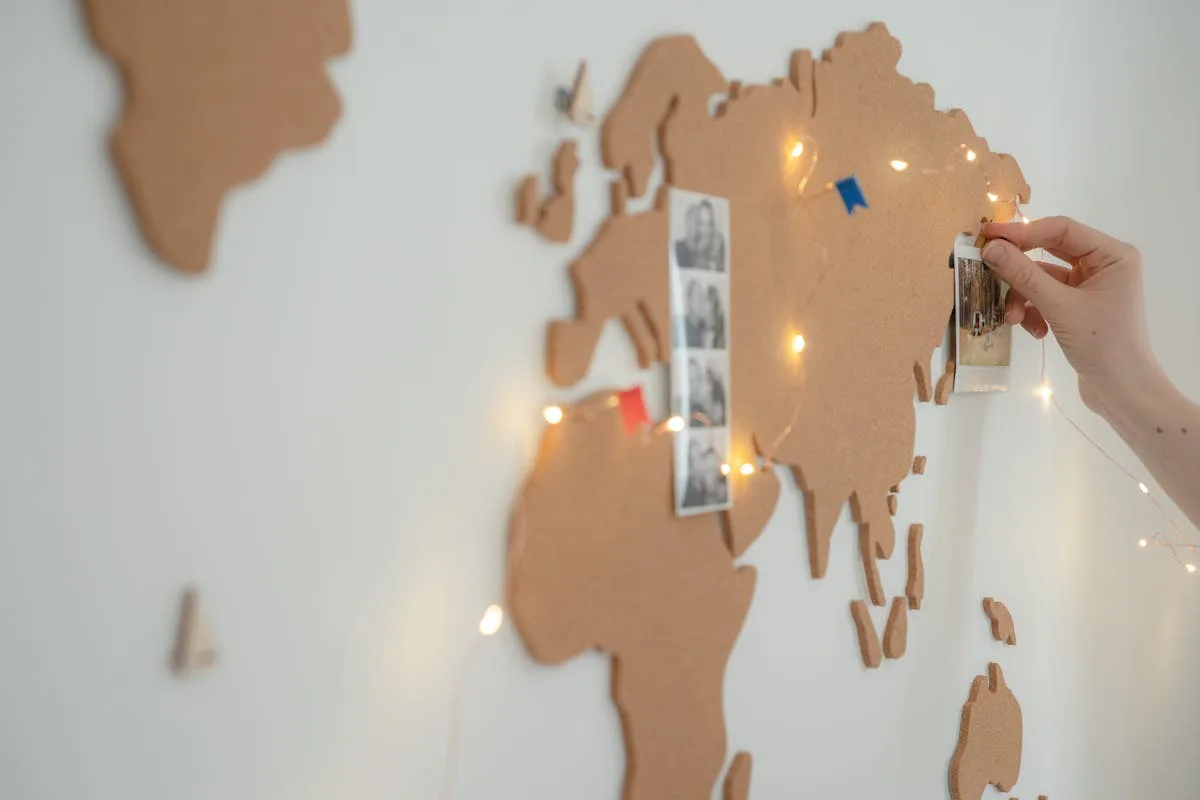
The vision boards that actually work look almost nothing like the ones that go viral on Pinterest. There is usually handwriting on them. There is often a sticky note that says something like “if it is Sunday, then I do the budget review.” They tend to live on the inside of a closet door in a studio apartment, or on a cork board screwed into a rental wall behind a desk, and they look like real life because they are pulling real life toward something.
Three goals. One photo each. One if-then plan. Five minutes of cutting and gluing, this week. You can build it from a poster board and your phone’s camera roll today, and refine it as your year clarifies.
For the shopping list, see the vision board supplies guide, which has the four-item starter kit. If you would rather skip the materials hunt entirely, the vision board kits roundup compares the paid options. Need 25 layout ideas to borrow from? The 2026 vision board ideas piece has them. Prefer a book format over a wall board? The vision board book walkthrough covers it. Building yours with friends? Our vision board party playbook covers hosting one that actually finishes a board. And if reflective paper crafts in general are your thing, our complete guide to junk journaling is the slower, journal-shaped sibling to vision boarding.
Want a starting pack of quotes and affirmations? Grab our printable vision board quote cards. A small bundle of anchor lines and affirmation prompts you can print at home and glue straight on the board. Sign up below and we will send it over.