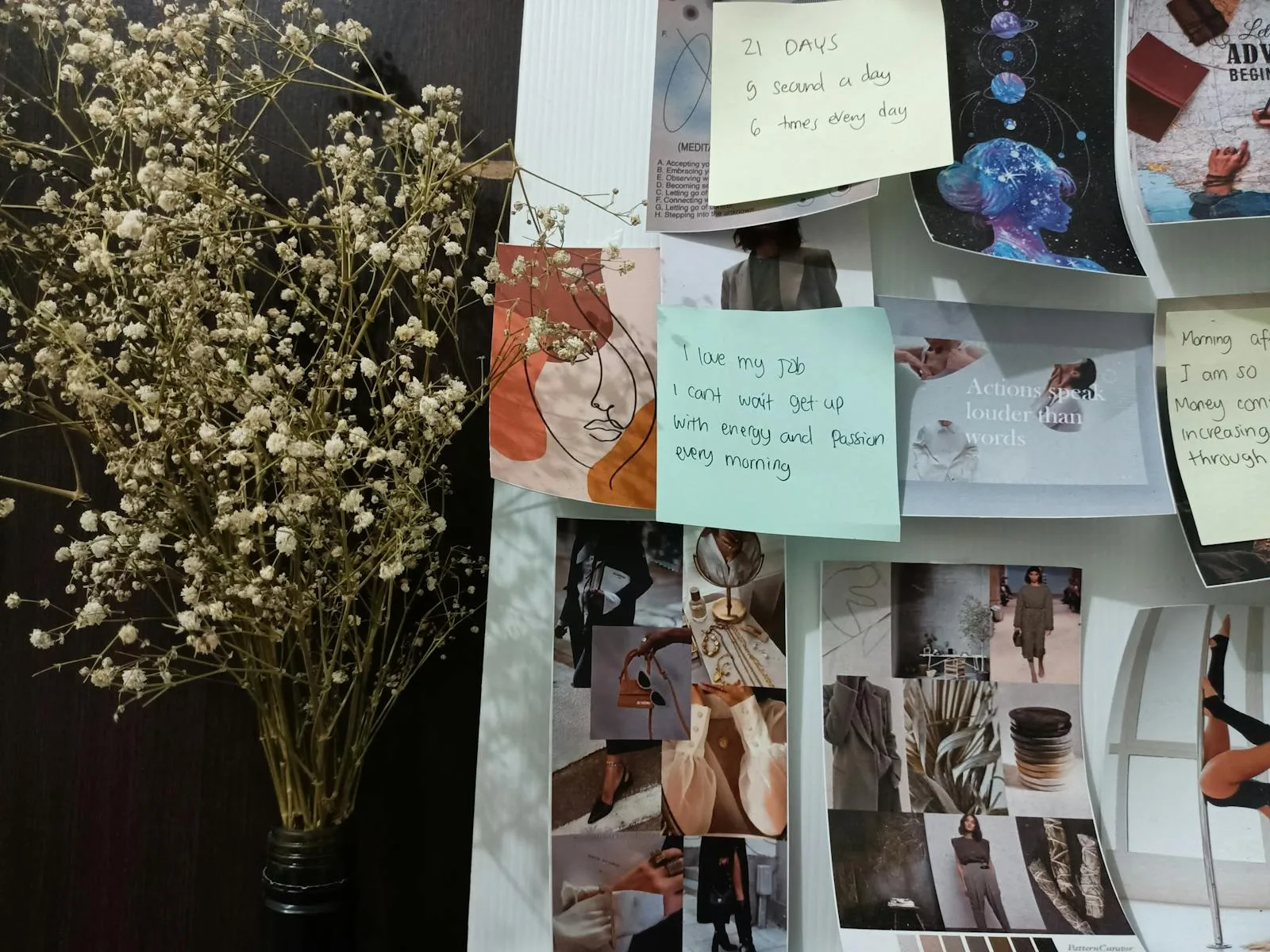
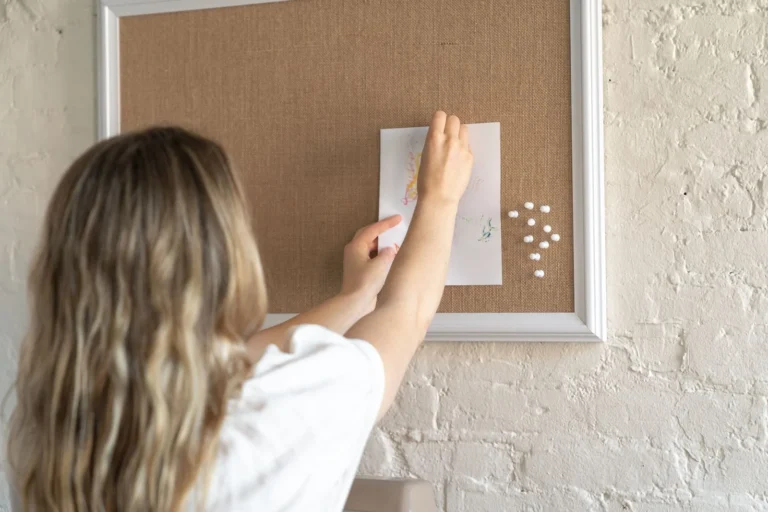
A goal-setting vision board uses images and short written goals together to make abstract intentions specific enough that your brain treats them as tasks instead of wishes. The board works because the goal is written in your own handwriting, dated, and visible from the place you drink your coffee.
You made the board last January. It was beautiful. It had a sunlit kitchen, a stack of books on a window seat, the words “save more, travel more, be more present” in small careful lettering. You hung it next to the bookshelf. By April you had stopped seeing it, by July you would have struggled to list three things on it, and by December it had migrated to behind the couch. The board did not fail. The goals did. “Save more” is not a goal, it is a feeling about money.
A goal-setting vision board fixes the part that breaks. Same poster, same magazines, same glue, but the words on the board do the heavy lifting. A goal that says “$3,800 in the savings account by November so the deposit on the apartment is ready” pulls you toward something specific every time you walk past. A goal that says “save more” pulls you toward nothing because there is nothing to pull toward.
The short version: Write four kinds of goals on the board: dated and specific, identity, experience, and relationship. Every goal needs a number or a date, every goal goes in your own handwriting, and every goal earns its image. Place the most important goal at the center where your eye lands first. Review on a calendar, not when you remember.
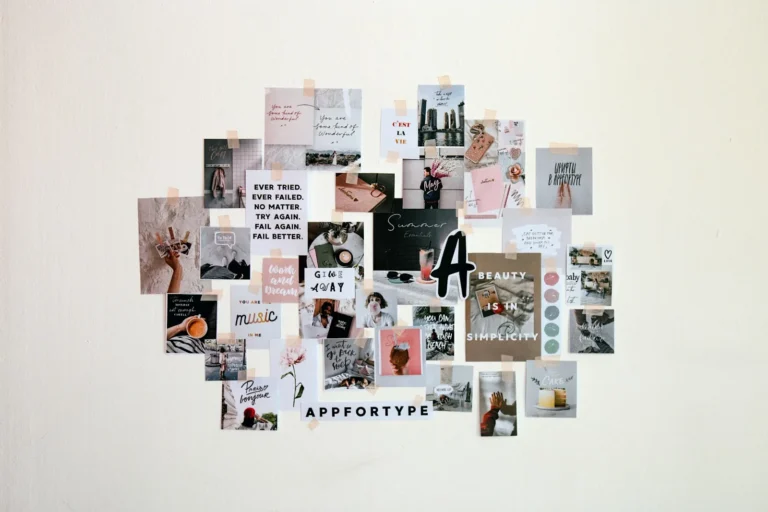
What a goal-setting board does that a mood board does not
A mood board collects images of a feeling. A goal-setting board commits to a sentence. Most vision boards quietly try to be both, and the goals on them go fuzzy as a result.
A goal becomes a doable thing once you can picture it. “Run a 10K in May” you can see; “be more active” you cannot, and your brain treats the two completely differently. The image on the board is the picture that holds the sentence in place. Printed goals from a Canva template feel like someone else’s homework, which is why your own handwriting matters more than the lettering looks fancy. And the visible goal nudges decisions in the background: you walk past the board on the way to the kitchen at 7am, you see the savings number, the pull to order takeout twice this week gets quieter without you announcing it to yourself.
If you are starting from scratch, the step-by-step build guide covers the placement and the visualization piece. This post is the part about what to actually write down.
The four kinds of goals every working board needs
Most boards skew heavily toward one kind of goal (usually career or money), and the board feels flat by month four because the rest of life is not on it. A goal-setting board with one goal in each of four categories holds attention for the full year.
1. Dated specific goals
One to three numerical or date-stamped outcomes, each writable in a single sentence. “$3,800 saved by November.” “First draft of the novel finished by April 30.” “10K run in under 70 minutes by May.” If you cannot put a number or a date on it, it goes in one of the other three categories, not here.
The board is allowed three of these and no more. Past three, the board starts feeling like a project tracker, not a vision board, and your eye starts skipping the goals the same way you skip a long to-do list.
2. Identity goals
Identity goals are about who you want to be when you do the thing, not what you achieve. “Someone who reads on her commute.” “The kind of person who calls her brother back the same day.” “Cook who makes dinner from what is already in the fridge.” Written in the present tense, not the future. The image next to it shows the act, not the trophy.
Two identity goals on a board is plenty. They keep working quietly even when a specific goal stalls, which is the year-saving function nobody mentions out loud.
3. Experience goals
Experience goals are things you want to do once, not master. A trip, a concert, a class signed up for, an evening with a friend you have not seen in a year, a meal cooked from a specific cookbook. One to three on the board, ideally with a soft date attached (“late spring,” “before October,” “this autumn”).
These are the goals that keep the year from feeling like only striving. Skip the category and the whole board reads as a quota by April.
4. Relationship goals
The most-skipped category, and the one that tends to matter most by December. A specific person to keep up with, a quality of attention you want to bring home, a habit around the people you live with. “Weekly call with mom, Sunday after coffee.” “Phone in the other room during dinner.” “Dad invited over for the May barbecue.”
One or two on the board. These often get the smallest visual real estate because the image is harder, but they earn the placement.
How to write a goal so it earns a spot on the board
A goal sentence does three things at once: names what, picks a date or number, and stays short enough to read in one glance. Three rules carry almost all the work.
Make it specific enough to picture. “Travel more” pictures nothing. “A weekend in Portland in October” pictures a hotel room, a coffee shop, a walk in the rain. If the goal does not generate an image in two seconds, the wording is too vague.
Attach one number or one date. Every dated specific goal has one of each, every identity goal has a frequency (“weekly,” “every Sunday”), every experience goal has a season or month, every relationship goal has a cadence. Without a number or a date, the goal stays a wish.
Keep it readable from across the room. Anything longer than ten words gets ignored once the board has been on the wall for a month. Cut adjectives. Cut throat-clearing words. The goal is a label, not a paragraph.
A test that works: write the goal, set the board across the room, look at it from the doorway. If you can read it without leaning in, it is short enough. If you have to squint, cut it in half and try again.
The number trick (and why “more” never makes the cut)
Look at every goal on a finished vision board. Cross out any goal with the word “more” in it. “Save more.” “Read more.” “Travel more.” “Be more present.” Now look at what remains. The board that survives the cut is the one that will still be working in October.
The word “more” is a comfort, not a direction. Your brain reads “save more” and dutifully agrees without a single useful change in behavior. Your brain reads “$3,800 in the savings account by November” and starts noticing the four-dollar latte differently. Same Sunday, same wallet, different result.
Replace every “more” goal with a number or a date:
“Save more” turns into “$3,800 in the apartment fund by November.”
“Read more” turns into “Twelve books finished this year, one a month.”
“Travel more” turns into “Two trips, one solo and one with the family, by October.”
“Be more present” turns into “Phone in the other room from six to eight every weeknight.”
Each rewritten goal is now a task with a finish line, and the board asks for a specific Saturday afternoon instead of a vague feeling.
Where to put goals on the board (placement actually matters)
A goal-setting board is not a random collage. Three placements do most of the work.
The anchor goal (the dated specific one that, if it lands, makes the year feel like a success) goes dead-center. Bigger image, bigger handwriting, more white space around it. If your savings number is the anchor, “$3,800 by November” sits in the middle in your own handwriting on a card big enough to read from across the room. Your eye lands there first every time you walk past, which is exactly the function.
Identity goals work better at the edges. They are quieter by nature, and the perimeter holds them without making them compete with the anchor for attention. Experience and relationship goals do well in the corners, one per corner so they read as a small grouping instead of a wall of equally weighted demands. Four corners, four corners, four lives the board is trying to hold.
The aesthetic vision board guide covers the visual cohesion piece (one palette, one paper weight, one image style). Placement is the goal-setting piece on top of that.
The review cadence (the part that decides whether the board works)
Most vision boards fail because there is no review schedule. You hang the board, your eye adjusts to it within three weeks, and after that the board functions as wallpaper.
A schedule that works:
Every Sunday: thirty-second glance. Walk over to the board, read all the goals out loud, walk away. No journaling, no thinking. Half a minute. The point is exposure, not analysis.
First Saturday of each month: five-minute check-in. What moved on each goal this month. Note one number on a sticky note next to the savings goal. Cross off the experience goal if the trip happened. Add a tally mark next to the identity goals. Five minutes maximum.
Quarterly: thirty-minute rework. What is no longer relevant, what got harder, what new goal sneaked in. Refold any goal whose number shifted. This is where the board stays alive across the year instead of going stale by April.
Without a review cadence the board ages into wallpaper by April. The cadence is the half of the project nobody photographs for Pinterest, and the half that decides whether the goals on it move.
Common goal-setting vision board mistakes
These five show up on nearly every chaotic goal board. Each has a five-minute fix.
Too many goals. Eighteen goals on one poster is a to-do list. Cap at seven across all four categories combined. If a goal cannot make the cut, it goes on a sticky note in a notebook and waits.
All goals are work goals. A board where every goal is a career goal feels grim by July. Force one identity goal and one relationship goal even if the year really is mostly about work.
Vague verbs. “Improve,” “increase,” “develop,” “explore.” Replace with verbs that have a finish (“write,” “save,” “run,” “call,” “cook”).
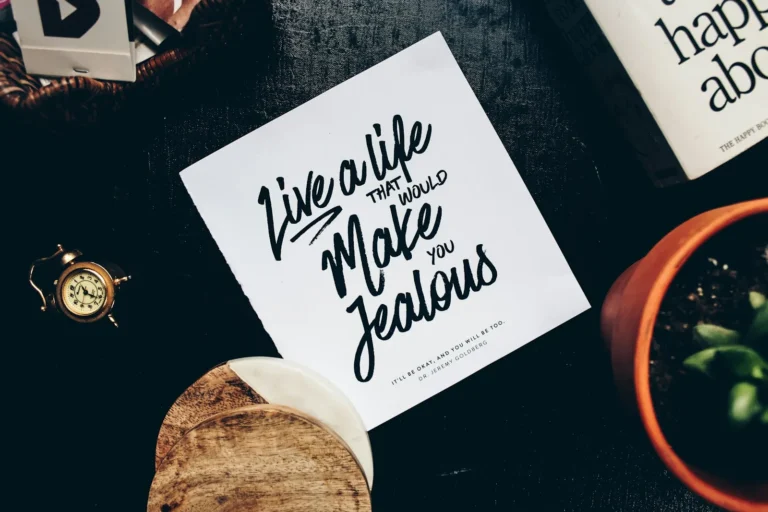
Other people’s printed quotes instead of your own goal sentences. Pinterest-printable quotes are decoration, not goals. Write the goals in your own handwriting; let the quotes be background, not headline.
Goals you copied off last year’s board. If a goal failed two years in a row, it is not your goal, it is someone else’s. Drop it. Replace with a smaller version (“read one book a month” instead of “finish 50 books”) or remove it entirely.
What to leave off a goal-setting board
A goal board is small. Everything on it is competing for the same wall space and the same five seconds of attention as you walk by, which means three categories of thing belong somewhere else.
Long-term life goals without a near step are the first. “Buy a house” might be a five-year goal, but the board needs the near step instead: “save $3,800 toward the down payment by November.” The five-year version belongs in a notebook where it can wait without taking up Tuesday morning. Vague aspirations without a verb are the second. “Happiness.” “Peace.” “Confidence.” These can show up as identity goals reworded (“do one quiet thing a day that I do not put on Instagram”), but never as standalone single-word labels. And the third is the goal you set because someone else thought you should. If you cannot picture yourself wanting it on a quiet Tuesday morning, it will not be yours by November either. Take it off and let the wall breathe.
The supplies list covers what you need to build the board itself; the goals are the part nobody else can pre-pack for you.
Frequently asked questions about goal-setting vision boards
What is the difference between a vision board and a goal-setting vision board?
A vision board shows the life you are heading toward; a goal-setting vision board adds specific written goals to that picture so you have something to act on every week. Both can hang on the same wall. A goal-setting board is the working version.
How many goals should a vision board have?
Five to seven across the four categories combined is the sweet spot. More than seven and your eye starts skipping. Fewer than four and the board does not have enough variety to hold attention across a full year.
Do I have to write the goals myself or can I print them?
Handwrite the goal sentences. Print the supporting quotes if you want. The handwritten goal carries different weight to your own brain than a printed one, even if you cannot articulate why. If your handwriting embarrasses you, write small and use a thin pen. Nobody else is going to read it.
How often should you update a goal-setting vision board?
Weekly glance, monthly check-in, quarterly rework. Replace the whole board once a year, usually around your birthday or in late December, not the morning of January 1 when the energy is hectic.
Can a goal-setting vision board be digital?
It can, and Canva makes it easy. The risk is that a digital board lives on your laptop, hidden behind a browser tab. The physical board’s only superpower is being visible from the kitchen. If you go digital, set the board as your phone wallpaper or your laptop background so you actually see it.
You will know the board is working when you find yourself adjusting a decision in real time (the latte, the unnecessary purchase, the Sunday afternoon spent on the couch) because the number on the savings goal walked through your head unprompted. Pick the four kinds, write seven sentences max, anchor the center, and the rest is just walking past it on the way to coffee.
Get free junk journal printables
New printables, page ideas, and paper craft tutorials, straight to your inbox.
Cork beats poster board for any vision board you keep more than a season. The four kinds of cork, how to mount on a rental wall, what you really need, and the maintenance habit nobody mentions.
The best vision board quotes are the ones you would actually say to yourself on a bad Tuesday, not the ones that look pretty in gold script. A Pinterest screenshot of “shine your light” does almost nothing for the goal-setting research that makes vision boards work. A handwritten “It is okay to be at the…
Vision boards work when they make you act differently, not when you stare at them. The collage is the easy part. The thing that turns a poster of dream apartments into a one-bedroom lease in March is a small daily change in what you notice, what you say yes to, and what you decide is…
The composition rules that turn a flat vision board into a layered collage. Focal image, three layers of depth, color palette, balance, breathing room, and five styles that work.
The only vision board supplies you actually need to start are a board, some images, scissors, and a glue stick. The Pinterest hauls with the gold-foil stickers and twelve magazine subscriptions are doing one thing well: separating you from your money before you have made a single page. You set aside a Sunday for this….
Manage Consent
To provide the best experiences, we use technologies like cookies to store and/or access device information. Consenting to these technologies will allow us to process data such as browsing behavior or unique IDs on this site. Not consenting or withdrawing consent, may adversely affect certain features and functions.
Functional
Always active
The technical storage or access is strictly necessary for the legitimate purpose of enabling the use of a specific service explicitly requested by the subscriber or user, or for the sole purpose of carrying out the transmission of a communication over an electronic communications network.
Preferences
The technical storage or access is necessary for the legitimate purpose of storing preferences that are not requested by the subscriber or user.
Statistics
The technical storage or access that is used exclusively for statistical purposes.The technical storage or access that is used exclusively for anonymous statistical purposes. Without a subpoena, voluntary compliance on the part of your Internet Service Provider, or additional records from a third party, information stored or retrieved for this purpose alone cannot usually be used to identify you.
Marketing
The technical storage or access is required to create user profiles to send advertising, or to track the user on a website or across several websites for similar marketing purposes.