You bought the notebook for the look of it, the clean dotted pages, the promise of spreads like the ones you saved. Then you tried to draw a straight habit-tracker grid freehand, the lines wandered, the boxes came out different sizes, and the page you meant to keep for a year looked like a rough draft on the first try. Here is the permission slip nobody hands you: you do not have to draw any of it. You can print it. A free template gets you a clean grid in thirty seconds, and once it is on the page, no one can tell whether you ruled it by hand or not.
A bullet journal template is a pre-made layout you download and print instead of drawing from scratch: a monthly spread, a habit tracker, a weekly page, ready to use. The best ones are free, and they do two jobs at once: they save you the ruler work, and they let you test a layout for real before you commit it to a notebook you care about.
The short version: Free bullet journal templates are printable layouts (spreads, trackers, logs) you download and print rather than draw. Use them to skip the freehand ruling and to trial a layout before redrawing it by hand. Print on plain paper, trim, and glue into your notebook, or print onto full sheets and use a printable-friendly journal. Start with a monthly spread, a weekly, and a tracker, and add only what you actually reach for.
The single biggest thing standing between a beginner and a notebook they keep is the fear of ruining the page. A blank dot grid is intimidating precisely because it feels permanent, and one crooked line early on is enough to make people quietly close the cover for good. Printables remove that fear entirely. If a layout does not work, you print another. Nothing is precious, so nothing stops you.
They also solve the honest skill gap. Hand-drawing neat grids and headers takes practice most people do not have on day one, and waiting until your lettering is “good enough” is just another way of never starting. A template skips straight to the using part, which is the only part that builds the habit. You can always graduate to drawing your own once the system has earned a place in your week.
What to print first
You do not need a binder of templates. Three printables cover almost everyone starting out, and you can add to the pile only when you hit a real need.
A monthly spread. Your overview page: a calendar grid plus a short task list for the month. The first thing to print, because it gives the whole month a shape before the daily noise begins. The weekly and monthly spreads guide covers how the monthly feeds your weeks.
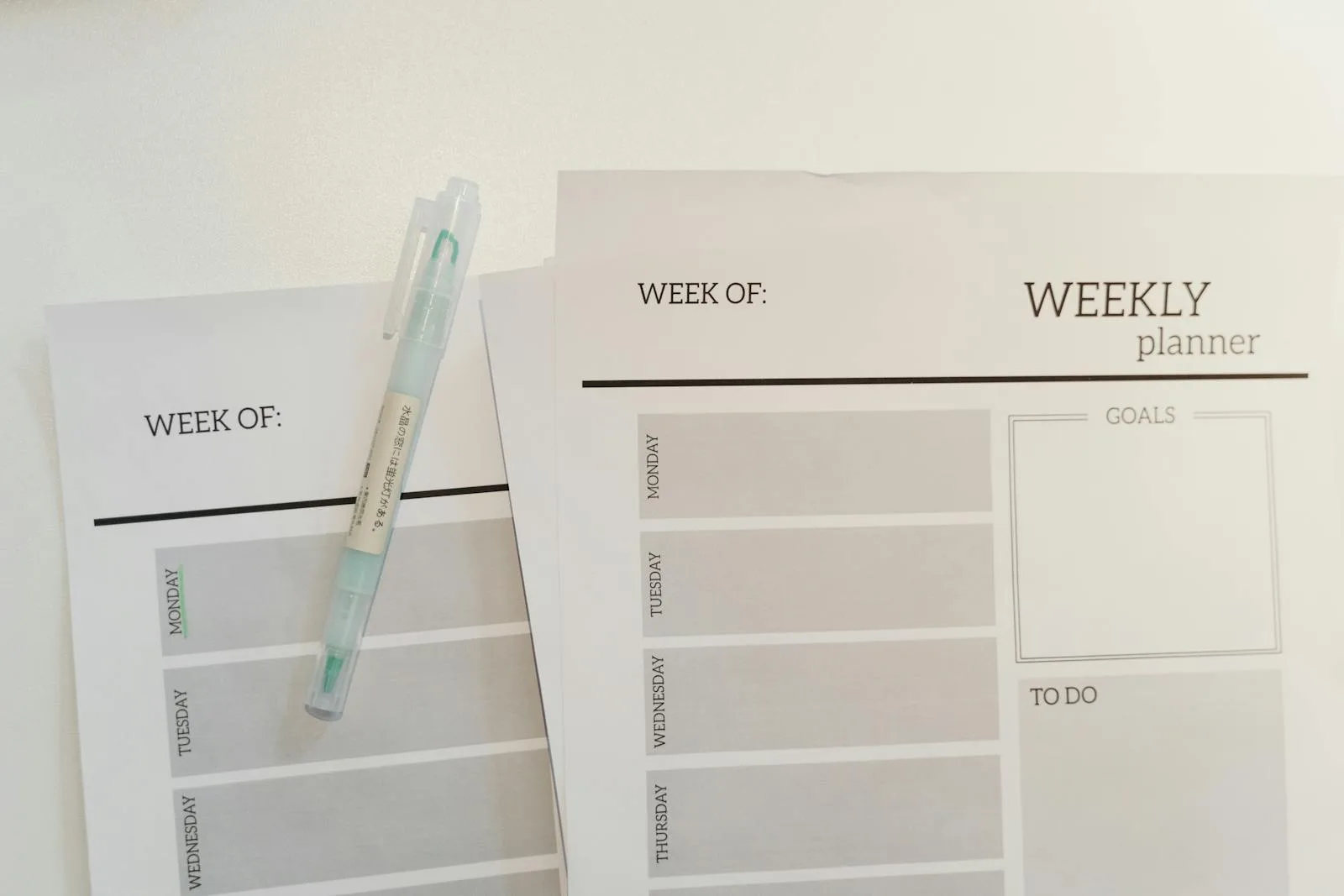
A weekly layout. The page you will open daily. Print a couple of different styles (a vertical with time slots, a simple horizontal) and see which one you actually fill in. That trial is the whole point of starting with printables.
A habit tracker. A grid of habits by days. Trackers are where freehand ruling goes most visibly wrong, so a printed grid is an easy win. How to design one so it survives the month is its own craft, covered in the habit tracker guide.
Add a mood tracker, a key card, or collection pages later, once you know you want them. A printable you never use is just paper.
The part most posts skip: how to actually use a printable
Downloading a pretty template is easy. Getting it into your notebook without it looking like a worksheet stapled to a page is the part nobody explains. There are four honest ways, and which one fits depends on your notebook and how much you care about the seams.
Print, trim, and glue in. The most common method. Print the template on plain paper, trim it a little smaller than your page, and glue it in with a thin layer or a glue stick. A trimmed edge and a clean glue line make it look intentional rather than tacked on. This works in any notebook.
Trace it. Slip the printable under your dot-grid page (against a window or a cheap light pad) and trace the lines you want. You keep your own paper and pen, and you get the layout without the ruler math. Best when you like your notebook’s paper and only want the structure.
Print straight onto loose sheets. If you use a discbound or ringbound journal, print onto full sheets, punch them, and add them right in. No gluing, no trimming, and you can rearrange pages later. This is where printables shine.
Use it as a reference, draw your own. Keep the template beside you as a model and freehand your version. Slower, but it is how you build the skill to eventually not need the printable at all.
One practical note: home inkjet ink can smudge under wet glue or marker. Let printed pages dry fully, glue at the edges rather than flooding the back, and test a marker on a scrap before you letter over a printed grid.
Where to find free bullet journal templates
You can spend money on template bundles, but you rarely need to when you are starting, and the free libraries are deep enough to find your whole system in.
Free printable craft libraries like Creative Fabrica. These carry large collections of printable bullet journal templates, spreads, trackers, and key cards, free to download and print on plain paper at home. It is the easiest place to grab several layouts at once and trial them before you settle on a style. We point to a starter set throughout this guide.
Craft blogs with email-signup downloads. Many bullet journal and planner blogs offer a free printable pack in exchange for an email. Useful for a specific layout you cannot find elsewhere.
Your own printer and a grid. Once you know what you like, you can make your own templates in a free tool and reprint them endlessly. The ultimate free option, and the one that fits your system exactly.
Whatever the source, the rule is the same: print free, use it for a couple of weeks, and only buy or commit a layout to your nice notebook once you know you reach for it.
Test, then keep the ones that earn it
The quiet trap with printables is hoarding them, a folder of two hundred templates you will never print. The point was never to collect layouts; it was to find your few. Print three or four, use them for a couple of real weeks, throw out the ones you ignored, and you will end up with a small, honest set that fits how you actually plan. That beats any mega-bundle.
If you are still setting up the notebook itself, how to start a bullet journal walks the basics, and bullet journal page ideas shows layouts worth printing or copying. Once you know your system, the supplies guide covers the notebooks and pens worth buying for the long haul.
Frequently asked questions about bullet journal templates
Are there free bullet journal templates?
Yes, and plenty of them. Printable craft libraries like Creative Fabrica and many planner blogs offer free downloadable bullet journal templates you print on plain paper at home: spreads, trackers, monthly and weekly layouts, key cards. Free libraries are deep enough that most beginners can build their entire system without paying for a bundle.
How do I put a printable into my bullet journal?
Four ways. Print on plain paper, trim it slightly smaller than your page, and glue it in. Trace the template through your own page against a window or light pad. Print onto full loose sheets if you use a discbound or ringbound journal and add them directly. Or keep it as a reference and draw your own. Gluing is the most common; let inkjet ink dry first so it does not smudge.
What templates should a beginner print first?
Three: a monthly spread for your overview, a weekly layout for daily use, and a habit tracker. Those cover most of what a beginner needs, and trackers and weekly grids are exactly where freehand ruling looks roughest, so printing them is an easy win. Add a mood tracker or collection pages only once you know you want them.
Can I print templates on regular printer paper?
Yes. Plain printer paper is fine for templates you will glue or trace, and it is the cheapest way to trial layouts. If you are printing onto loose sheets to keep in a discbound journal, slightly heavier paper holds up better to daily use and bleeds through less, but for testing, ordinary paper does the job.
Is it cheating to use printables instead of drawing?
Not at all. The bullet journal system is about capturing and organizing your life, not about hand-lettering. Printables get you using the method on day one instead of waiting until your drawing is good enough, and plenty of long-time journalers print their spreads for years. The hand-drawn look is a hobby layered on top, not the point.
Print one tonight and stop fearing the page
That intimidating blank grid was never a test of your drawing. It was just a layout you had not printed yet. Grab a free monthly spread, a weekly, and a tracker, run them off on plain paper, and glue or trace them in, and the notebook you were scared to ruin becomes one you actually use. Drawing your own can come later, once the habit is real and you want to.
Want a set ready to print? Our free printable bullet journal starter kit gives you a clean monthly spread, a weekly layout, a habit tracker, and a daily log, everything above in one download you can print at home tonight. Sign up below and we will send it over.
Get free junk journal printables
New printables, page ideas, and paper craft tutorials, straight to your inbox.
You opened someone’s bullet journal once, maybe a friend’s, maybe a photo online, and the page looked like a code you were not cleared for. Dots and dashes, little arrows, a star in the margin, one task with a neat line through it. It seemed like you needed a decoder ring just to read a…
You spent the better part of an evening on a spread you were proud of. Headers lettered, a tracker laid out, a little color in the corners. Then you turned the page to start the next day and there it was, the whole layout ghosting through from the back, the marker bleeding into shadows of…
Sunday night, fresh week ahead, and you are staring at two blank pages trying to remember how you laid out last week, the good one, the week the journal actually worked. Was it the vertical columns? The one with the box in the corner for the brain dump? You cannot quite recreate it, so you…
You saw the spread online first. Clean dotted page, a hand-lettered header, a little watercolor wash in the corner, a habit tracker that looked like a piece of art. So you bought the notebook and the good pens, opened to page one, and sat there. The blank dot grid stared back, the cursor of paper,…
Every January it goes the same way. You buy the notebook, you fill in three perfect days, then life happens, you miss a Tuesday, and the unmarred pages start to feel like an accusation. By the twentieth the notebook is in a drawer and you have decided you are just not a bullet journal person….
You can’t draw. You have decided this about yourself, somewhere back in a childhood art class, and now every time you see a bullet journal with a little banner header and a row of tiny potted plants down the margin, you file it under “not for me.” Here is the thing the people drawing those…
Manage Consent
To provide the best experiences, we use technologies like cookies to store and/or access device information. Consenting to these technologies will allow us to process data such as browsing behavior or unique IDs on this site. Not consenting or withdrawing consent, may adversely affect certain features and functions.
Functional
Always active
The technical storage or access is strictly necessary for the legitimate purpose of enabling the use of a specific service explicitly requested by the subscriber or user, or for the sole purpose of carrying out the transmission of a communication over an electronic communications network.
Preferences
The technical storage or access is necessary for the legitimate purpose of storing preferences that are not requested by the subscriber or user.
Statistics
The technical storage or access that is used exclusively for statistical purposes.The technical storage or access that is used exclusively for anonymous statistical purposes. Without a subpoena, voluntary compliance on the part of your Internet Service Provider, or additional records from a third party, information stored or retrieved for this purpose alone cannot usually be used to identify you.
Marketing
The technical storage or access is required to create user profiles to send advertising, or to track the user on a website or across several websites for similar marketing purposes.