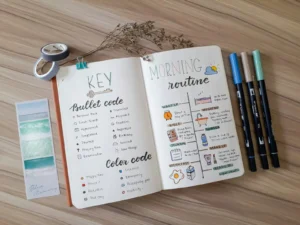
Sunday night, fresh week ahead, and you are staring at two blank pages trying to remember how you laid out last week, the good one, the week the journal actually worked. Was it the vertical columns? The one with the box in the corner for the brain dump? You cannot quite recreate it, so you wing a new layout, it does not fit how this week actually goes, and by Wednesday you have stopped writing in it. The fix is not a better memory. It is settling on a couple of spreads that match how you really plan, and then reusing them until they are automatic.
A spread is just the layout you draw across one or two pages to plan a stretch of time, a month seen wide or a week up close. Get the relationship between those two right and the journal stops being a craft project you reinvent every Sunday and starts being a tool you reach for without thinking.
The short version: A monthly spread gives you the month at a glance for planning; a weekly spread is the daily workhorse where the real to-dos live. Most people need both, with the monthly feeding tasks down into the weeks. Pick a weekly layout that matches your life, vertical for time-blocking, horizontal for light task days, dailies for unpredictable ones, then reuse it until it is automatic instead of redesigning every week.
The mistake that makes spreads feel like busywork is treating the monthly and weekly as two versions of the same thing. They are not. They sit at different altitudes.
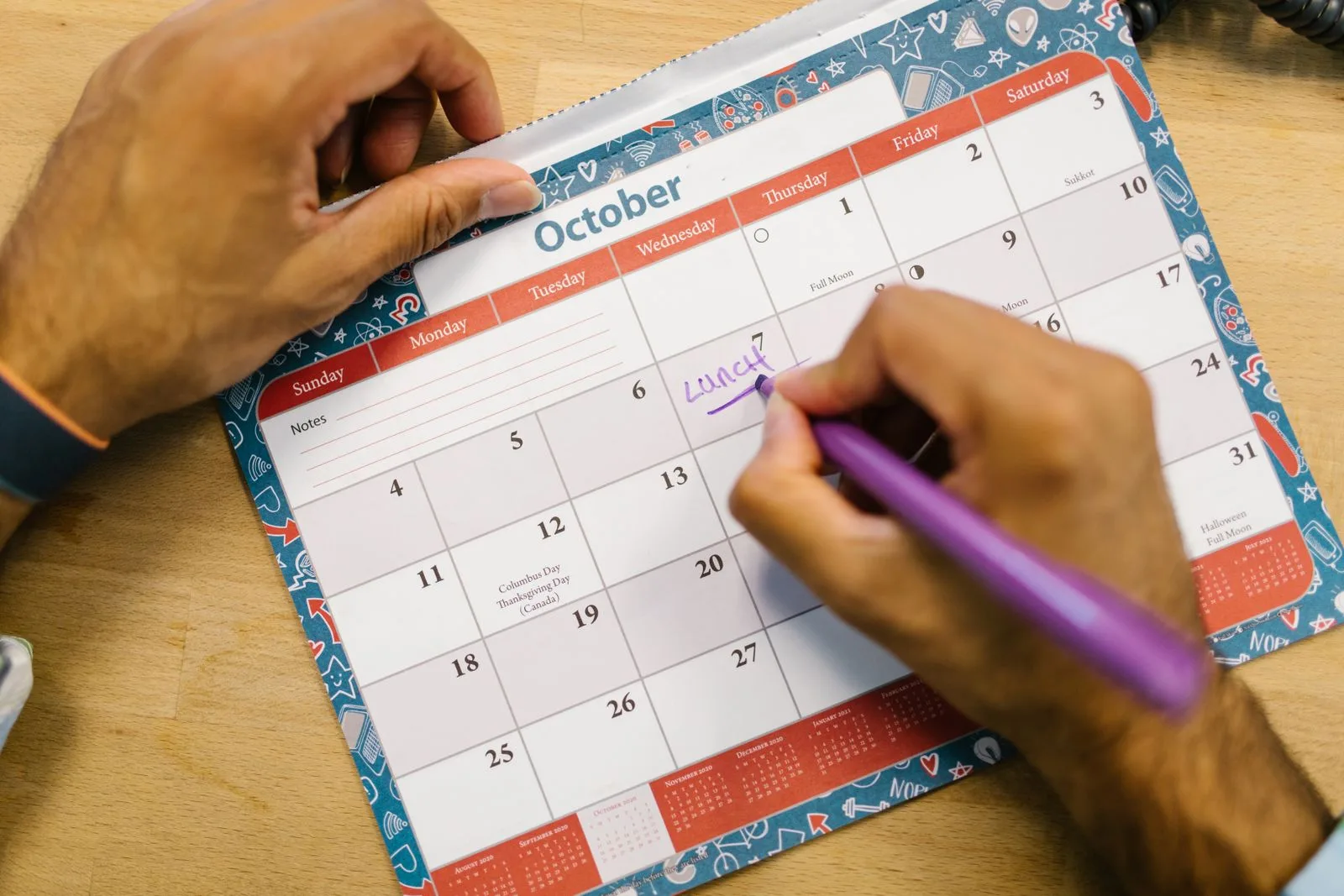
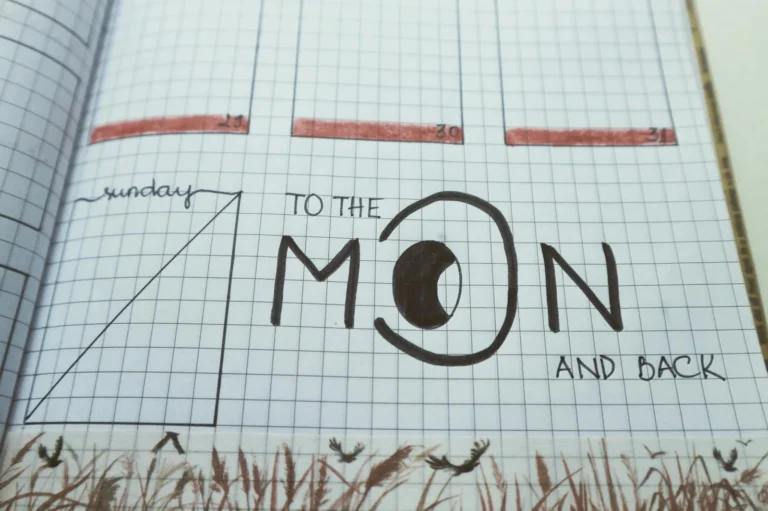
The monthly spread is the wide lens. Set it up at the start of each month and it holds the things you need to see coming: appointments, birthdays, deadlines, a short list of what the month is actually about. You do not run your daily life from it. You glance at it to know the shape of the weeks ahead, then it feeds the details down into each week as that week arrives. Setting up a fresh monthly is also the natural moment to carry forward unfinished tasks, the review the original system calls migration, which the bullet journal hub digs into properly.
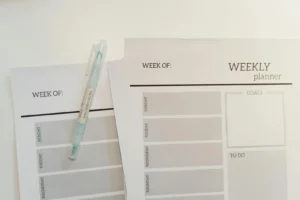
The weekly spread is where you live. It is close-up: this week’s seven days, the tasks and events and notes that actually need doing now. If the monthly is the map, the weekly is the road you are driving. Most people find they need both, because running everything from a monthly page gets cramped fast and running everything from weeklies means you lose the big picture. The two together are what make the system hum.
Choosing a weekly layout that fits your actual week
Here is the part worth slowing down on, because the weekly spread is the one you touch every day, and the wrong shape for your life is why so many get abandoned. There is no best layout, only the one that matches how your days actually run. Three honest archetypes cover almost everyone.
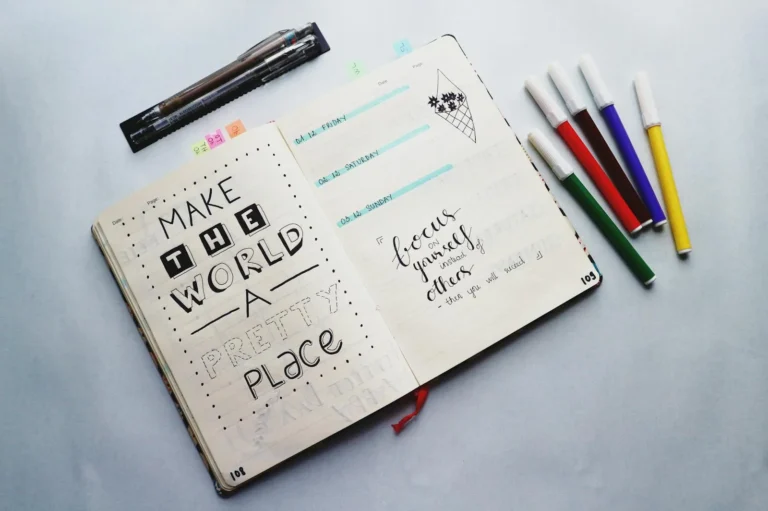
The vertical weekly. Seven columns across the page, often with hour markers down the side. This is the layout for time-blocked lives, students with a class timetable, anyone whose day is a sequence of appointments. You can see Tuesday at 2pm at a glance. It is the most structured option and the most wasteful if your days are loose, because half the columns sit empty.
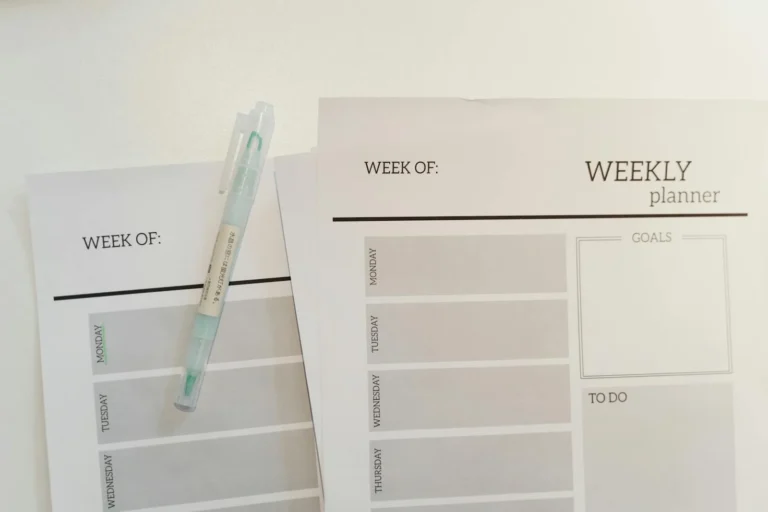
The horizontal weekly. Seven rows stacked down the page, each a day, each a short open space for that day’s list. Calmer and more flexible than the vertical, ideal when your days are about a handful of tasks rather than a packed schedule. The most forgiving default, and the one to start with if you are unsure.
The dailies-as-you-go. No pre-drawn week at all. You write the date at the top of a fresh space each morning and rapid-log the day, letting busy days take more room and quiet ones take three lines. Perfect for unpredictable lives where a fixed grid would just waste paper, and the closest thing to the original plain system. The trade-off is no week-at-a-glance view, so it pairs best with a solid monthly.
A quick test: think back to last week. Was it mostly timed appointments (go vertical), a shifting list of tasks (go horizontal), or wildly different day to day (go dailies)? Match the layout to the week you actually had, not the orderly one you wish you had.
Spread anatomy: the few pieces worth adding
Once you have a base layout, a handful of small modules make a weekly spread genuinely useful. Add them only if you will use them; an empty module is just clutter you drew on purpose.
A brain-dump or notes box. A corner left open for the stray thoughts that do not belong to any single day. Quietly the most-used piece on most people’s pages.
A top-three. Three priorities pulled out of the long list and given their own corner, so the week keeps a point even when the to-dos pile up.
A small tracker. A mini grid riding along the bottom of the week keeps a habit or your mood in view on the page you already open daily. The design of those is its own craft, covered in the habit tracker and mood tracker guides; here, just know a slim one fits a weekly beautifully.
A meals or errands strip. A thin row for dinners or shopping, if those are the things that actually derail your week. Skip it if they are not.
The discipline is subtraction. A spread crammed with eight modules looks impressive and takes twenty minutes to draw, which means you will not draw it on a tired Sunday. Two or three modules you genuinely use beat a page full of boxes you fill out of obligation.
Reuse beats redesign
This is the quiet truth behind every journal that actually lasts: the people who keep weekly spreads are not the ones who design a stunning new layout every Sunday. They found a layout that works in month one and then drew the same one, week after week, until setting it up took four minutes and zero decisions. The reinvention is what burns people out, not the upkeep.
So once a layout clicks, stop shopping. Let it get boring. A plain spread you actually draw and use all week is worth ten gorgeous ones you abandon by Thursday. Save the experimenting for a single test week now and then, and keep your standard week standard. If you want a gallery of layouts to borrow from while you find your default, bullet journal page ideas is full of them.
Test layouts free before you draw them in
The fastest way to find your weekly is to try a few without committing your notebook. Print a vertical, a horizontal, and a dailies-style page, use each for a real week, and notice which one you keep reaching for and which leaves columns empty. That is far more telling than picking the prettiest one online.
There is a free library to test in: Creative Fabrica’s printable weekly and monthly spreads download free and print on plain paper, so you can run a layout for a week before drawing it by hand. The free bullet journal templates post collects a starter set to try. Once a layout earns its place, redrawing it takes minutes.
Frequently asked questions about bullet journal spreads
What is the difference between a weekly and a monthly spread?
A monthly spread is your overview, set up at the start of the month to hold appointments, deadlines, and goals so you can see the shape of the weeks ahead. A weekly spread is the close-up workhorse you open daily to run the actual days. The monthly feeds tasks down into each week; most people use both, because one without the other either gets cramped or loses the big picture.
Do I need both a weekly and a monthly spread?
Most people do. The monthly catches the things coming weeks out and gives you a planning view; the weekly handles the day-to-day. That said, if your life is very routine you might run on monthlies alone, and if it is very unpredictable you might lean on dailies with just a light monthly. Start with both and drop one only if you genuinely never use it.
Which weekly spread layout is best for beginners?
The horizontal weekly, seven rows stacked down the page with a little open space each. It is the most forgiving: flexible enough for shifting task lists, not so structured that empty columns make it feel like a failure. Start there, and switch to a vertical layout only if your days turn out to be packed with timed appointments.
How do I stop redesigning my spread every week?
Pick a layout that works in your first month, then deliberately reuse it instead of starting fresh each Sunday. The journals that last belong to people whose weekly setup became automatic, no blank-page decisions left to make. Let your standard week get boring; save experimenting for the occasional test week rather than every week.
How long should it take to set up a weekly spread?
Once you have settled on a layout, about four or five minutes. If your spread regularly takes fifteen or twenty, it has too many modules or too much decoration, and that is exactly the kind of setup people quietly abandon. A fast, plain spread you actually draw beats an elaborate one you skip when you are tired.
Find your two spreads and stop reinventing the week
You do not need a new layout every Sunday. You need a monthly that shows you the month and a weekly that fits how your days actually run, drawn the same way often enough that setting them up stops being a decision. That is the difference between the journal you reinvent and abandon and the one you reach for without thinking.
Try a few layouts free, keep the weekly you actually reach for, and let it get boring. If you are still setting up the notebook, how to start a bullet journal walks the basics, and the bullet journal hub ties the whole system together. The good week you could not recreate was never about a perfect layout. It was about a spread that fit, used twice.
Want spreads ready to print? Our free printable bullet journal starter kit includes a clean monthly spread, a weekly layout, and a daily log you can print at home and use this week. Sign up below and we will send it over.
Get free junk journal printables
New printables, page ideas, and paper craft tutorials, straight to your inbox.
You bought the notebook for the look of it, the clean dotted pages, the promise of spreads like the ones you saved. Then you tried to draw a straight habit-tracker grid freehand, the lines wandered, the boxes came out different sizes, and the page you meant to keep for a year looked like a rough…
You quit the first time because the journal started asking too much. Every spread online had hand-lettered headers, a color theme, a little illustration in the corner, and somewhere along the way keeping the notebook stopped being planning and became a nightly art assignment you were too tired to do. So you skipped a day,…
You flip back through last month and one thing jumps out before you read a single word: the Sundays are all the same grey. You never noticed it living through them, one ordinary low Sunday after another blurs into “fine,” but colored in across a page, the pattern is impossible to miss. That is the…
Every January it goes the same way. You buy the notebook, you fill in three perfect days, then life happens, you miss a Tuesday, and the unmarred pages start to feel like an accusation. By the twentieth the notebook is in a drawer and you have decided you are just not a bullet journal person….
The very first page is where a surprising number of bullet journals die before they begin. You open the new notebook, you know the first page is “the cover,” and suddenly it carries the weight of the whole thing. It has to set the tone. It has to be good. So you put it off…
You saw the spread online first. Clean dotted page, a hand-lettered header, a little watercolor wash in the corner, a habit tracker that looked like a piece of art. So you bought the notebook and the good pens, opened to page one, and sat there. The blank dot grid stared back, the cursor of paper,…
Manage Consent
To provide the best experiences, we use technologies like cookies to store and/or access device information. Consenting to these technologies will allow us to process data such as browsing behavior or unique IDs on this site. Not consenting or withdrawing consent, may adversely affect certain features and functions.
Functional
Always active
The technical storage or access is strictly necessary for the legitimate purpose of enabling the use of a specific service explicitly requested by the subscriber or user, or for the sole purpose of carrying out the transmission of a communication over an electronic communications network.
Preferences
The technical storage or access is necessary for the legitimate purpose of storing preferences that are not requested by the subscriber or user.
Statistics
The technical storage or access that is used exclusively for statistical purposes.The technical storage or access that is used exclusively for anonymous statistical purposes. Without a subpoena, voluntary compliance on the part of your Internet Service Provider, or additional records from a third party, information stored or retrieved for this purpose alone cannot usually be used to identify you.
Marketing
The technical storage or access is required to create user profiles to send advertising, or to track the user on a website or across several websites for similar marketing purposes.